Note: The original title of this had been "Perpetuating Our Miscommunications, Feeding Our Own Fears, and Clinging to Old Karma." After finishing the post, I felt a little different about it. I no longer felt like it focused on those characteristics, but rather on leaving them behind.
Heh, I must admit, my Ho’oponopono recitation (*see footer) was helpful the moment I realized that's what this was.
A friend of mine recently posted on Facebook an amused and politely annoyed update regarding his family and the commentary he overheard about him regarding his dislike of Fox News. As I started my comment, I failed to really ever stop typing, and wound up with a long observational blog update. (In fact, I accidentally sent him most of the entire post by accident. Just kept typing and typing and pressed Enter to skip a line, only to submit the comment. My bad!)
It's just such a sad thing, really. I imagine the disruptive members of Fox news, along with that image we often pull up of the cliched "viewer," have all the best intentions despite how dishonest and hateful they can be. They think those who aren't "there" with them are just going down the wrong path or something. And we look at them and get so frustrated. We inadvertently feed them the picture of those who are bitterly in denial, and the two groups sort of miserably react along this same cycle of misunderstandings and misinformation. We feed each other the bad things we expect from each other, and perpetuate a problem.
It's a great micro-sociology representation of so many of our problems, utilizing simple media preferences. That situation is the result of the interactions between a deeper mix of ideologies, and how they manifest themselves in our information sources (and therefore how we reenforce our most familiar and easily-digested reality.) Arguably, this mini-situation illustrates the way in which we develop, exist-within, reenforce, and viciously protect our reality and sense of self. Even with a solution in sight, we're likely more concerned with not losing this personal identity than we are concerned with solving society's (and therefore the world's) problems. How disappointing.
If we didn't function on such extremes at the moment, we might be able to recognize this objective narrative of our constant fear, knee-jerk reactions, self destruction, finger-pointing, judgment, assumptions, and hate. If we'd stop reenforcing our own behaviors and fighting so hard to be right, or be the best, or be the richest, or be the most powerful, then maybe we could finally cut the karmic cycle. If we could just admit that discovering the truth is more important than being right, then we might not be so afraid of ever being wrong. What the hell are we afraid of...
If everyone could just STOP, and decide "I'm done," and start the hell over--no focus on past deeds or past disagreements, no constant search for a reason to distrust, no insecurities about the past or about our lives (which rules out a need to search for worth or meaning outside of our own growth and goodness)--then maybe we'd be on to something.
If we were all willing to forgive. Everything, including ourselves. Most importantly ourselves...
...then I think we'd fix it.
We have to be willing to be wrong about anything, and we have to care. About everyone. Everything. Specifically, we have to respect everything, because we can recognize it.
We have a huge responsibility, being so aware.
We have been granted the ability to be aware of the possibility of a reality outside of our own, while simultaneously being a part of those other realities, while simultaneously observing those other realities. We can imagine the "other side," the rest that isn't "me" or "you." We can grow and learn outside of ourselves, essentially knowing and being aware of everything, even the stuff that isn't us. WE COULD BE EVERYTHING, TOGETHER. This isn't pro-science or anti-universal-oneness (as that is what I view to be the underlying message of our highly symbolic and abused religions. I chose not to use the word "religion" for a reason; I don't want to give the impression that I think there is a man with a white beard in outer space.)
This is the culminating potential of existing. Not one of us is entirely right or entirely wrong. None of us have a complete image of our universe or what we're doing. We have various explanations for the reality outside of ourselves, and what we should do with that information. (I won't lie, I feel some of these explanations are more reliable and constructive than others.) We're capable of breaking the boundaries between our realities. We're the only things stopping ourselves. Don't you feel empowered?
If we'd just stop and remember our potential, and how hard we worked and fought to get this far in our biological and therefore psychological development, maybe we'd stop taking it for granted. Maybe we'd stop telling ourselves that with all this power, intelligence, ingenuity, curiosity, and freedom, that we also therefore have no need to try any harder.
Too often we live just for us, because in being aware of perspectives outside of my own, I suddenly feel very naked and insignificant. I have too much freedom and only tend to respond when not doing so will cause me immediate harm. Without any barriers, I HAVE SO MUCH TO DO. It's a lot of responsibility, isn't it?
Too often we close up into our own like-minded groups and do everything we can to retain our very limited worldview. We're not even aware that we're doing it. We think we're happiest when we have a nice, dependable, guided existence. It limits our abilities because it limits our purpose (be it to go to heaven or be fleeting and rot in a casket), and therefore there is no great impetus to KEEP IMPROVING. After all, we already know the outcome, and we don't wanna have to do *too* much work when surviving is already work enough as it is. Especially with all these pesky assholes who keep threatening to make me question my worldview!
So we say, "screw everyone/everything else. I'm living for my comfort."
And that isn't to say everyone feels this way, nor does it so that those who do feel it 100% of the time. That's what's so important. All of it is fear and misinterpretations, and we shouldn't make wide assumptions about anyone. We shouldn't hate someone who doesn't know what they're doing, let alone how to stop. In reacting so negatively and perpetuating the sense of distrust and disapproval by projecting that ourselves, we prove to be just as afraid and just as flawed. All we do is worsen that feeling of an imposing threat upon their person in some way, and they retreat from any possible revelations all the more vehemently. Forgiveness and maturity and a desire to be harmonious can't be one-sided, here.
So I asked, what if we just decided to stop, and to be intelligent, empathetic adults? What if we forgave everything as part of living this human experience, and stopped expecting more disappointments? It's difficult to imagine it because our experiences up until the present have sculpted us. We can't change our functioning reality at the drop of a hat. It takes a lot of work and dedication, and is a lifelong effort.
It's the process of seeing yourself in others, and seeing how we all effect everything else. It's the process of absolute forgiveness and unconditional love, to use a pair of overused but no less accurate phrases. It's the process of an ever evolving sense of self and sense of the universe. It's the process of enlightenment.
It's time we remembered to keep participating. So many already are, did you know? It's already happening. You're reading this. You're ready to do it. We're doing it.
I’m sorry.
Please forgive me.
Thank You.
Ho’oponopono.
And with that ending, I'd like to point out that this posting was purposefully ambiguous (for the most part) regarding which "mindset" I was speaking about the most. Yes, I am part of this human experience, too, so I have my own perspective on it. Clearly, I find myself more on the "anti-Fox-news," "pro-science" side of the fence. But once again, being a human being doesn't stop me from seeing and fully understanding other human beings. The message is poignant for all readers. Turn it back on yourself and see the way some of the observations may fit parts of your life. (It was certainly therapeutic for me to write it.) I could be speaking about fundamentalist Christians, radical Islamists, Mormons, or Atheists, for example. We all hate to be wrong, and therefore we all think we are the ones who are "right." Some are more open to correction than others, true. (And there again my personal perspectives and biases against the oppressive extremes of most religions rears its human head.) But let me be clear, I've seen some really angry, mean-spirited, self destructive extremes in atheism and obsession with any one particular "branch" of science. Once again, drawing into another extreme perpetuates this internal and external schism.
Point being, I think this blog post can be read to/for multiple kinds of people. Think of it as objectively biased, I suppose? Remember that it comes from my perspective and so it will contain my version of things. That doesn't mean the story of self-preservation doesn't apply to everyone.
This is a group effort that begins within each of us.
(*) For more information about Ho'oponopono, "ancient Hawaiian practice of reconciliation and forgiveness," see this Wikipedia article on the subject for a general understanding of the concept, and see this interview with Dr. Hew Len regarding his experience with the practice in a mental hospital.
Showing posts with label empathy. Show all posts
Showing posts with label empathy. Show all posts
Monday, December 31, 2012

Sunday, December 23, 2012
Avoiding the Trap of Logical Fallacies While Fighting the Good Fight.
Lately I feel as though a part of my personality of which I have been ashamed in the past has matured and morphed (through no small effort) into something far more useful and worthwhile. Much of my childhood and young adulthood was experienced through very judgmental eyes. It was never enough just to experience the world around me; I had to have an opinion on it! In fact I would argue that constantly thinking and branching into dozens of possible reactions/happenings/sources/explanations has kept me from truly focusing on the matter at hand. I consider myself to have an overly active (and often uselessly analytical) mind, with perhaps a dash of ADD. I wouldn't be surprised if this is why it's so hard for me to remember anything.
I have a reason for sharing this somewhat troublesome self discovery, of course. Coinciding with my “adult” efforts to curtail my judgmental personality—and therefore be a more peaceful and likable person—is a growing desire to see situations from as many perspectives as possible. While this often results in seeking a highly objective perspective (which really sounds too oxymoronic to be used accurately), it also leads to playing the part of the Devil's advocate from time to time. I like to think that what was once a knee-jerk reaction to what I found to be unpleasant behavioral characteristics has become a permanent, empathetic sociological and/or psychological study. (Side note: I find it's harder to hate people when you can see their perspective, no matter how you may disagree with their behavior; that is a very freeing state of mind, I must say.) None of this is to say that I don't fall back into my old judgments, of course. I am a human being with much to learn and experience, after all.
I have, however, noticed a great deal about human behavior.
That having been said, I'd like to talk for a moment about the kind of thinking that I've witnessed in the last year or so of activism and really paying attention to the world around me. This will come in sections as a series of updates to this first post, as it turns out I have a lot more to say than I had originally thought (now that I've started writing and am returning to this paragraph some time later to make this addendum.)
I'd like to preface this post with the following: I make these blog posts to share my thoughts, in the hopes that it will serve others in some way. I know that I “use my words well,” and that my obsessive desire to express myself as clearly as possible may in fact help clarify some things for some people who find themselves perplexed by or perhaps even unaware of some of the behaviors around them. Perhaps readers will learn something about themselves. It's certainly been an enlightening experience for me. Understanding how and why we behave the way we do is often more important than just the behavior itself. I sometimes think about this not because I want to point out people's mistakes, but because I want to be helpful. I understand perfectly well that can be hard to believe, and I also understand just why that is. Knowing that, however, won't stop me from trying.
The subject of this “discussion” is the common use of logical fallacies to form arguments or even whole philosophies. I could spend days dredging up every single flawed argument I've heard in just the last few months, so I'll likely stick with those which have stood at the most and therefore come to mind most readily. I'd also like to add that I don't actually partake in these arguments very often. I really dislike confrontation. That isn't to say I'm particularly afraid of being wrong (though no one likes that feeling.) Rather, the confrontation itself makes me extremely anxious, as though I'm at the risk of being physically attacked at any given moment. I'd need a whole other blog post (or two) to explain from where my general anxiety stems. I'm pretty familiar with it (thanks a lot, Childhood Repercussions.)
There are so many more fallacies to discuss, but this has taken forever to write already and the ones listed above are the most obvious to me at the moment. I encourage everyone to take a look at this list of logical fallacies and to consider the ways in which you or people around you have relied on them in the past. (For an even longer list, check out this link.)Take care not to assume everything is a fallacy, of course. The goal is to learn, not to flay ourselves or others.
"Honorary mention" goes to the Argumentum ad Logicam, or "The Fallacy" Fallacy, in which one assumes that because a fallacy has been made, the entire argument is incorrect. (This is similar both to the Tu Quoque [above] and False Analogy fallacies [in which someone uses an analogy as proof of something, rather than as an illustration of something.]) I see this utilized most commonly when someone is searching for a reason to no longer have to absorb information which goes against the grain of his/her own beliefs, and so uses a person's bad choice of words or bad argument as a reason to ignore the truth.
I find it to be closely linked to a fallacious appeal to intelligence, in which a speaker might say "obviously this is the case," or "anyone can see that such-and-such is true." In making such a statement, the speaker urges listeners to assume intelligent people would have "gotten it," and because they may have thought otherwise, they must not be intelligent enough to "get it." This one is extremely common.
But please, don't abuse what you think you know about fallacies in order to stop listening to others, and don't judge yourself too harshly. It's all a learning process.
I have a reason for sharing this somewhat troublesome self discovery, of course. Coinciding with my “adult” efforts to curtail my judgmental personality—and therefore be a more peaceful and likable person—is a growing desire to see situations from as many perspectives as possible. While this often results in seeking a highly objective perspective (which really sounds too oxymoronic to be used accurately), it also leads to playing the part of the Devil's advocate from time to time. I like to think that what was once a knee-jerk reaction to what I found to be unpleasant behavioral characteristics has become a permanent, empathetic sociological and/or psychological study. (Side note: I find it's harder to hate people when you can see their perspective, no matter how you may disagree with their behavior; that is a very freeing state of mind, I must say.) None of this is to say that I don't fall back into my old judgments, of course. I am a human being with much to learn and experience, after all.
I have, however, noticed a great deal about human behavior.
That having been said, I'd like to talk for a moment about the kind of thinking that I've witnessed in the last year or so of activism and really paying attention to the world around me. This will come in sections as a series of updates to this first post, as it turns out I have a lot more to say than I had originally thought (now that I've started writing and am returning to this paragraph some time later to make this addendum.)
I'd like to preface this post with the following: I make these blog posts to share my thoughts, in the hopes that it will serve others in some way. I know that I “use my words well,” and that my obsessive desire to express myself as clearly as possible may in fact help clarify some things for some people who find themselves perplexed by or perhaps even unaware of some of the behaviors around them. Perhaps readers will learn something about themselves. It's certainly been an enlightening experience for me. Understanding how and why we behave the way we do is often more important than just the behavior itself. I sometimes think about this not because I want to point out people's mistakes, but because I want to be helpful. I understand perfectly well that can be hard to believe, and I also understand just why that is. Knowing that, however, won't stop me from trying.
The subject of this “discussion” is the common use of logical fallacies to form arguments or even whole philosophies. I could spend days dredging up every single flawed argument I've heard in just the last few months, so I'll likely stick with those which have stood at the most and therefore come to mind most readily. I'd also like to add that I don't actually partake in these arguments very often. I really dislike confrontation. That isn't to say I'm particularly afraid of being wrong (though no one likes that feeling.) Rather, the confrontation itself makes me extremely anxious, as though I'm at the risk of being physically attacked at any given moment. I'd need a whole other blog post (or two) to explain from where my general anxiety stems. I'm pretty familiar with it (thanks a lot, Childhood Repercussions.)
- The Slippery Slope Argument, in which one asserts that allowing one thing to happen will inevitably and unavoidably lead to another, previously unforeseen result, and therefore that first thing must not be allowed. This is both fully self explainable and worthy of an entire blog post in and of itself. Simply put, the use of this fallacy requires one to draw a number of assumptions—assumptions which I have found to be based more out of personal fear than any real fact. Now that their fears are apparently right at the back door, that fear rules the rest of the conversation. There can be no focus on how far from reality their argument has been taken. The only focus, now, is the supposedly imminent danger brought about by the idea in the first place. The most obvious example of this fallacy at work is within the gay marriage debate. A broadened definition of the concept of “marriage” clearly leads to bestiality and, eventually, legal marriage between species. This must be true, despite the fact that those two fears have nothing to do with the matter at hand: the fact that two consenting human adult homosexuals want to have the same legal and social rights as consenting human adult heterosexuals. The leap to bestiality has absolutely no basis in the reality of the original argument, but that Slippery Slope argument consistently stops progress on the discussion as though it actually means anything.
Not to mention the fact that this argument assumes that every possible idea/demand that every member of the public could ever possible conjure up must immediately be accepted by the law, and that there's no possible way such a legislative decision might be avoided do to its complete illegitimacy. - The Strawman Argument, in which someone's argument is misrepresented in order to make it easier to attack them. I see this constantly. Common examples include the belief that wanting universal healthcare for all makes you an democracy-hating communist/socialist; the belief that women who speak out against misogyny are men-hating feminists (helping to create the resultant belief that “feminism” has a direct correlation with “hating men,” and thereby producing the “straw-feminist”); and the belief that those who speak out against the present plutocratic state of America (protesting the abuse of resources and privileges made by the wealthy both in terms of economic and government affairs) are either too lazy/unmotivated to work hard enough to earn true (i.e. monetary) success, or hate capitalism and money and therefore probably America (or all of these things, simultaneously.)
At the same time, I also have seen—and have personally participated in—the reverse of that last fallacious argument. It's so easy to assume everyone who speaks out against public spending, true religious freedom, or sacrificing personal luxuries for the sake of making the world a better place (e.g. reducing/eliminating pollution, reducing material waste, preserving our resources, protecting other species, respecting other species, etc) feels that way for purely selfish, possibly even vindictive reasons, and that they are therefore bad, heartless people. It's easy to pigeonhole them into an inaccurate caricature and hate them.
But if we consider the perspective of the person trying to help free the world from powerful corporations, of the person trying to awaken the public to sexism in what is its most popular and institutionalized form at the present, and of the person trying to encourage more effort be exerted by everyone in order to be less of a constant cancer on the Earth (rather than instantly writing them off and assuming they have no idea what they're talking about or specifically want to hurt you), then we may just be able to fix some of our problems. After all, things have only continued to get worse with our current way of doing things. Trying something else, *gasp!* may actually be a pretty good idea.
Meanwhile, activists can't fall back on hating those who don't believe them. I've spoken extensively on the need to forgive and empathize, and to consider the preceding lifetime of every individual presently participating in these global conversations. Everyone feels the way they do for a reason. When we take the time to understand those reasons, we can then avoid boiling a whole person with a whole history which has made him who he is today, down into a simplified and hopeless strawman—and nothing more. - The Tu Quoque Argument (Latin for "You, also"), in which Person A avoids facing criticism provided by Person B by pointing out how Person B has made the same mistake(s) in the past. An appeal to hypocrisy should not be allowed to derail a conversation. Just because both (or all) parties have fallen into behaviors against which they are presently speaking out, that does not make those behaviors any less acceptable. Equal guilt doesn't negate the act itself. I saw an example of this very early on in the Occupy movement, when onlookers, news anchors, pundits, and internet comments appeared to take great joy in pointing out that so many of the folks protesting corporate greed and blind consumerism were utilizing the tools purchased in that same corporate environment.
Separately, there are actually three things wrong with that, however. The most obvious issue is the Tu Quoque Fallacy at work, which I have already explained. Another issue is the assumption that buying goods is itself a hypocritical act in that particular situation (which in a way is the Strawman Fallacy at work again, simplifying the demands and rallies of the masses to a simple “owning stuff and having money is bad!”) A third issue is the assumption that it is a) viable to avoid all of these products by also assuming there are comparable alternatives, and also b) hypocritical to use the devices of the “machine” in order to “get back at it.” In a world where instantly worldwide digital communication is often a person's only security against irreparable police brutality and “cover-ups,” there are literally no other options but to use these tools. - The Black-or-White Argument, in which someone creates and/or defends the illusion that there are only two possible solutions (or sides) to a given problem. Sometimes this is used to increase his/her chances of successfully “winning” the debate. It misleads those trying to partake, and suppresses what might otherwise have been a rational appeal to other circumstances, perspectives, variables, etc. Sometimes it's interesting to see how eager people are to limit themselves in this way, particularly when the only two sides/solutions they can see fail to serve them in any way. For many, there are only two options: Materialism of religion (which for some boils down to Science or Not Science); economic success or a failed life; Capitalism or Dictatorship (as communism and socialism are often perceived as forms of absolute control, and therefore little more than a “group dictatorship.”)
It doesn't occur to us to consider that maybe something that doesn't presently fit most obviously with our individual view of science can in fact be “scientific.” It doesn't occur to us that there may still be things beyond our current comprehension, or at the very least, outside of our current pool of ideas. It doesn't occur to us that we can be more happy with less, if we value quality over quantity. It doesn't occur to us that money is still just a tool, and therefore we control it, and therefore we can do whatever we want to with it, and so are not limited to just the (failed) attempts at a long term, stable economy thus far attempted by mankind. We limit ourselves, and harm ourselves in so doing. - The Anecdotal Argument, which I have discussed at length in a previous post, recently reposted here: Personal Anecdotes Often Do Not Negate an Argument.
I'd like to add, here, that I have another example for the Anecdotal Argument that I did not mention in that blog post, and that is the assumption that because someone has not personally experienced something, it is therefore impossible. I was involved with (but mostly witnessed) a discussion within a group regarding bringing barter and trade systems back into local communities, rather than relying entirely on currencies. An individual assumed that because he personally could not recall a time in which people were satisfied with a good deed without monetary repayment (which he later realized was entirely untrue), he assumed therefore that deeds would only be done if money was promised in return, regardless of the necessity of the deed. This ignored the fact that with all of the people, labor, and resources available to a community, and with all needs met, there's little reason that a well structured community of empathetic individuals would be unable to function effectively and assist those in need. People assume that it's money that drives all good deeds, not merely because it's the right thing to do and they are more than capable of doing it. - The Bandwagon Argument, in which it is assumed that popularity makes something true, as though an idea's popularity automatically makes that argument more valid. (It is at times very similar to the Appeal to Authority fallacy, as we will notice.) I see this most recently in the form of quotes from famous political, social, and religious figures/texts. This is not to say that using a quote or reference from a reputable source is wrong. It also doesn't mean that it's wrong to share ideas or sources of inspiration via quotes. Not at all. When we have looked long and hard at an issue and find that a quote from a related, reputable source happens to speak this idea very well, that quote can be a very useful tool. However, simply relying on these quotes to decide an entire ideology, make whole decisions, or sway masses of people is not at all an intelligent way to solve problems or sculpt ones own philosophies. Just because someone says something well doesn't mean what they said was accurate, and it doesn't even mean that their words apply to the situation at hand. It seems to me that we rely on such quotes too often, rather than having meaningful discussions.
I'd like to stress one last time that there is nothing wrong with using quotes. Sometimes someone else says something we feel/think very poignantly, after all, and sharing a quote from a respectable source can really help make people think twice about the validity of their stance. People must always think for themselves, however. Quotes do not “win” an argument. - The Special Pleading Argument, in which the rules/guideposts of someone's argument constantly change in order to work around and therefore avoid any proof that is placed in the way of their reasoning. (At times similar to the Texas Sharpshooter fallacy.) I see this put into play all the time. While everyone uses fallacious thinking at some point in their lives, the Special Pleading fallacy is one which I would assume is particularly common for us. After all, we hate to be wrong.
The most obvious and immediate example I have for this involves arguments in which religion is used as a “reason” for someone's decisions and/or morals. It's actually a comical use of the fallacy, as the bible and other Christian works are so inclusively and exclusively contradictory that someone could go 'round and 'round a subject forever using excerpts to “prove” how something is right or wrong. Jesus said to love thy neighbor, to turn the other cheek, and not to condemn others to hell. That is what is expected of others when dealing with the speaker. But when it's time for the speaker to offer the same thoughtful self control, then it's time for “the bible says homosexuality is a sin,” or “it's my duty as a Christian to try to convert nonbelievers or inform sinners,” or “God says to destroy my non-christian neighbor, take his wife, and murder his children and livestock.” (Actually that last one isn't very popular, and I find that hilarious.)
There are so many more fallacies to discuss, but this has taken forever to write already and the ones listed above are the most obvious to me at the moment. I encourage everyone to take a look at this list of logical fallacies and to consider the ways in which you or people around you have relied on them in the past. (For an even longer list, check out this link.)Take care not to assume everything is a fallacy, of course. The goal is to learn, not to flay ourselves or others.
"Honorary mention" goes to the Argumentum ad Logicam, or "The Fallacy" Fallacy, in which one assumes that because a fallacy has been made, the entire argument is incorrect. (This is similar both to the Tu Quoque [above] and False Analogy fallacies [in which someone uses an analogy as proof of something, rather than as an illustration of something.]) I see this utilized most commonly when someone is searching for a reason to no longer have to absorb information which goes against the grain of his/her own beliefs, and so uses a person's bad choice of words or bad argument as a reason to ignore the truth.
I find it to be closely linked to a fallacious appeal to intelligence, in which a speaker might say "obviously this is the case," or "anyone can see that such-and-such is true." In making such a statement, the speaker urges listeners to assume intelligent people would have "gotten it," and because they may have thought otherwise, they must not be intelligent enough to "get it." This one is extremely common.
But please, don't abuse what you think you know about fallacies in order to stop listening to others, and don't judge yourself too harshly. It's all a learning process.
Tuesday, December 4, 2012
Repost: The Move to Secede (It's not as simple as you think)
Recently there's been a little uproar about the move of several states (proposed by citizens, not the state legislature, of course) to secede from the Union. It's easy to wag our fingers at these people, as this became public information in the media immediately after Barack Obama was elected for a second term. However, this is not news. That is, the threat to secede has been working its way to a head for years, and not necessarily for reasons you may be thinking. This blog post is not meant to as a cry of support for these threats, but as an attempt to help folks understand the movement a little more accurately.
Over the past year or so, I've been exploring numerous websites discussing dirty financial and political dealings between America and a host of Asian, European, and Middle Eastern nations for many decades (most of what I've read revolved around our dealings with China and Japan, but that limitation is likely due to my sources.) There has been so much information, and combined with the loose research I've done into other scandalous activities (wars, industrialization of medicine, control of education, suppression of energy technology, etc.) I can't even begin to regurgitate it here. Know simply that we owe many nations a great deal of money. We are refusing to provide government bonds for gold which we took under false pretenses. Individuals seeking to utilize the bonds they were given are being arrested for doing so, in part because the notes they have were purposefully falsified just in case they were ever "cashed out." Our underhanded treatment of other countries is reflected our treatment of U.S. citizens, most certainly.
In the mean time, we are losing our ability pursue life, liberty, and happiness. I mean this quite literally. In a basic hierarchy of needs, we must have food, water, and shelter before we can begin growing mentally and emotionally. When the masses are too busy trying to find employment, afford terrible food, and avoid a lifetime of medical debt, they don't have the time or the will (or, usually, the education) to seek to improve themselves--as individuals or as a society. Enlightenment of any kind is unattainable when our most basic needs are not met. Our brains don't function as well and our bodies grow ill and weak. Here are the ways in which America keeps its citizens from those three "God-given" rights:
Unfortunately, we have very few choices. (Graph of the few largest companies we're most familiar with: http://www.convergencealimentaire.info/map.jpg) Meanwhile, we are punished for trying to separate ourselves from this system. For example, living off-grid is increasingly difficult, and individuals find themselves fined and forcibly dragged back into the energy grid. (http://offgridsurvival.com/livingoffthegridcrime/) Eating well is next to impossible, as almost everything on the shelves is pumped with GMOs (proven to cause cancer and organ failure in tested animals, among other complications), MSG (proven to affect parts of the brain and central nervous system), pesticides, modified starches and oils, and is stripped of all nutritional value. We are are malnourished while being morbidly obese.
Our political system is tightly reined by wealthy companies. Our laws are heavily influenced by the financial preferences of these corporations. (Graph of the names and companies which control every aspect of our lives--all linked to the Bilderberg Group, which is entrenched in our politics: http://cloud.decryptedmatrix.com/live/wp-content/uploads/2012/06/Ultimate_Bilderberg_Flowchart_Connected_Politicians_Corporations.jpg) It should be known that many of the cosmetic, food, pesticide, and drug additives we use so liberally in the U.S. have been banned in most other first-world countries because they are so dangerous. Marijuana is illegal here not because it hurts users, because it lessens our reliance on some pharmaceuticals--and because its cousin, hemp, eases the monopoly on certain building and clothing materials. (And arguably, because marijuana encourages a different kind of thinking and a release of our egoistic vice-grip on reality as it is--the reality of this ridiculous system. If the issue was personal damages, then alcohol would also be illegal. In a country where we pride ourselves on our individual liberties, we cannot tell adults what they consume in their private lives.)
So what does all this have to do with the threat by people in so many states to secede from the union? I would hope it would be clear, by now. People are tired of being victims in their own country. People are tired of being slowly murdered by their medicine, their food, their banks, and their politicians--even if indirectly. People are tired of being forced to support companies which destroy our planet, abuse the animals we eat (http://www.farmsanctuary.org/learn/factory-farming/), and abuse the money of their consumers. People are tired of being arrested for practicing their constitutional rights. People are tired of paying for war. People are tired of being afraid. There have been plans for years to secede from the union with the intent of rebuilding while out from under this massive, oppressive thumb.
But this is where it gets complicated (hahaha.) No one person can speak for everyone else. Some people will jump on the Secession Bandwagon because they hate Obama (and a shocking number of people hate Obama for purely racist reasons, even if they are not aware of it themselves.) Some people will support secession because they think America is falling apart because of increasingly "tolerance" of homosexuality, religious freedom (including freedom to not partake in any religion), and racial mixing. What's important to note here, however, as that this is not everyone. People are supporting this for many different reasons.
Meanwhile, the media did not begin to highlight this movement until immediately after the 2012 elections, drawing attention not to the core of the movement, but to the population of racists within it. Trust me, this is not accidental. But the movement is not defined by the racism which exists in pockets of its population, just as Occupy Wall Street was not defined by the hateful extremists which cried out for the death of the rich. (God damn it, that was infuriating.) That kind of extremism is harmful to a cause, yes, but it is not the center of it.
I think it is safe to say that no state will actually secede. The driving force behind the threat is the last-ditch effort to grab the attention of our branches of government. "The people are mad," they cry. "Stop ignoring us. Stop forcing us into lifestyles of which we do not approve. Stop misrepresenting us. Stop destroying our planet. Stop seeking profit over people. Stop encouraging ignorance and disease. Stop tricking us out of our money. Stop dangling political puppets in our faces in an attempt to turn us against each other. Stop telling us that consuming will solve our problems. Stop lying. Stop bombing. Stop!"
For the record, I neither support nor ridicule the threats to secede. I feel things are too complicated to be so black and white, and I fear the backlash of those who ridicule the movement will separate the people, rather than uniting them against their abusive Corporate Government. (Rather than divide ourselves, I would suggest looking into this: http://www.represent.us/#video. Represent Us is championing The American Anti-Corruption Act, which "gets money out of politics, so the people can get back in." The following website explains the AACA: http://anticorruptionact.org/.) I also have no idea what the numbers are. I don't know how many people want secede because Obama is black, or how many want to secede because he signed the NDAA, or how many want to seceded for both reasons. From some perspectives, it won't matter. Common ground and wider understanding are what matter. Lincoln didn't abolish slavery strictly for one reason, either, but the eventually result, while not perfect, was absolutely necessary and extremely positive, wouldn't you agree?
Over the past year or so, I've been exploring numerous websites discussing dirty financial and political dealings between America and a host of Asian, European, and Middle Eastern nations for many decades (most of what I've read revolved around our dealings with China and Japan, but that limitation is likely due to my sources.) There has been so much information, and combined with the loose research I've done into other scandalous activities (wars, industrialization of medicine, control of education, suppression of energy technology, etc.) I can't even begin to regurgitate it here. Know simply that we owe many nations a great deal of money. We are refusing to provide government bonds for gold which we took under false pretenses. Individuals seeking to utilize the bonds they were given are being arrested for doing so, in part because the notes they have were purposefully falsified just in case they were ever "cashed out." Our underhanded treatment of other countries is reflected our treatment of U.S. citizens, most certainly.
In the mean time, we are losing our ability pursue life, liberty, and happiness. I mean this quite literally. In a basic hierarchy of needs, we must have food, water, and shelter before we can begin growing mentally and emotionally. When the masses are too busy trying to find employment, afford terrible food, and avoid a lifetime of medical debt, they don't have the time or the will (or, usually, the education) to seek to improve themselves--as individuals or as a society. Enlightenment of any kind is unattainable when our most basic needs are not met. Our brains don't function as well and our bodies grow ill and weak. Here are the ways in which America keeps its citizens from those three "God-given" rights:
- The food (and its production methods) provided by our most powerful agricultural companies are harmful not only to us, but to the environment. When individuals try to fight back, these companies actually have the rights of the people reduced. (http://www.dailyfinance.com/2010/02/04/monsanto-the-evil-corporation-in-your-refrigerator/)
- The medicine provided to us is controlled by pharmaceutical companies which are far more interested in long term financial gain than in actual cures. We create treatments, not cures. We do not remove the causes, but deal with the symptoms. Rather than fix our food and our living conditions, we create a campaign to make diabetes a "livable condition." We prepare to have a population in which 50% of adults are diabetic by 2020, rather than working to avoid it (http://abcnews.go.com/Health/Diabetes/diabetes-half-us-adults-risk-2020-unitedhealth-group/story?id=12238602). We treat our diseases and ailments like vague, unavoidable instances of misfortune; while our poisoned society, poisoned food, poisoned medicine, and negative (poisoned) psyche makes us far more susceptible to things like heart disease, cancer, autism, etc. Don't buy Komen's pink ribbons. They are not creating cures. (http://www.nakedcapitalism.com/2012/09/the-drugs-dont-work-how-the-medical-industrial-complex-systematically-suppresses-negative-studies.html)
- Supplements are not properly regulated, and therefore the ratios provided are often ineffective. The food, supplement, and nutritional allowances provided by the Food And Drug Administration are often false, if not specifically misleading and dangerous (and are made with the specific intent of encouraging The People to continue buying into entities like Big Agri and Big Pharma.) In part because of this, the use of supplements is mocked by the media and the FDA. (http://relivecorp.wordpress.com/2010/06/05/fda-suppression-of-truthful-health-claims-for-nutritional-ingredients-and-supplements-is-destroying-our-future/)
- Our energy is provided by a small collection of companies (energy which is required for us to live well and therefore should be a right, not a commodity) which provide us with old and earth-damaging technologies, while other countries are implementing far more wide-scale alternative energy solutions. Even in terms of combustion engines, Europe utilizes engines that are more than twice as fuel efficient as the engines sold in America. They are legal to produce here for sales to other nations, but they are illegal to sell here. (http://www.naturalnews.com/036183_fuel-efficiency_automobiles_government.html)
- Our news and media in general are controlled by very few companies. (See this infographic: http://static2.businessinsider.com/image/4fd9ee1e6bb3f7af5700000a/media-infographic.jpg) Most of our news outlets stay far away from actual news, preferring to focus all attention on local scandals and partisanship. They repeat the same stories--even the same exact wording-- because it has been approved by a few political heads. Just look at the focus on the Petraeus scandal, while war has erupted in Israel and America is dumping its assets into the fray (all while you are dubbed a racist anti-Semite if you do not support Israel's war.) (http://www.naturalnews.com/036609_mainstream_media_White_House_influence.html)
- Our communications technology (constantly under government surveillance, especially recently) is outdated and slow compared to other first-world countries, but that limitation allows the handful of companies which sell these services to charge exorbitant fees for a simple product. "Digital" technology is simple, and we pay ridiculous amounts of money for it because so few companies compete. (http://internetdistinction.com/blog/2011/11/02/susan-crawford-communications-crisis/)
- Our education system is laughable. The uneducated are easier to control, struggle for employment, and work harder just to live. Our history is altered to suit the desires of the Powers That Be. Our science is not emphasized and little of it is required in most public schools. Personally, I am finding that fewer and fewer children communicate effectively with their native language. We continue to rank lower and lower in international tests with other nations. (http://www.huffingtonpost.com/2012/07/23/us-students-still-lag-beh_n_1695516.html.)
- Our prison system is nothing more than a Prison-Industrial Complex. It makes incredible amounts of money while doing nothing to benefit our society. We make everyone into criminals (especially minorities) and ruin countless families. (http://www.publiceye.org/defendingjustice/overview/herzing_pic.html)
- Recently, steps have been taken to strip our rights to privacy and information (SOPA, PIPA, news suppression, TSA abuse, etc) and our rights to a trial by jury, our rights to due process, and our rights for fair treatment if suspected of illegal activity ("On December 31, 2011, President Obama signed the National Defense Authorization Act (NDAA), codifying indefinite military detention without charge or trial into law for the first time in American history." http://www.aclu.org/blog/tag/ndaa)
- (In relation to these points, the argument for Rights vs Commodities is impossible to have, as money for the individual is far more important than happiness for the many. However, as times change, we change. As we change, our technology changes. We have the resources, technology, and man power to produce all of the natural food [with nutritional requirements met], earth-safe energy, and mass communications systems for everyone in the planet. There is no need to treat these things as limited resources anymore. More specifically, we can understand their limits without having to fearfully keep them "all to ourselves.")

Unfortunately, we have very few choices. (Graph of the few largest companies we're most familiar with: http://www.convergencealimentaire.info/map.jpg) Meanwhile, we are punished for trying to separate ourselves from this system. For example, living off-grid is increasingly difficult, and individuals find themselves fined and forcibly dragged back into the energy grid. (http://offgridsurvival.com/livingoffthegridcrime/) Eating well is next to impossible, as almost everything on the shelves is pumped with GMOs (proven to cause cancer and organ failure in tested animals, among other complications), MSG (proven to affect parts of the brain and central nervous system), pesticides, modified starches and oils, and is stripped of all nutritional value. We are are malnourished while being morbidly obese.
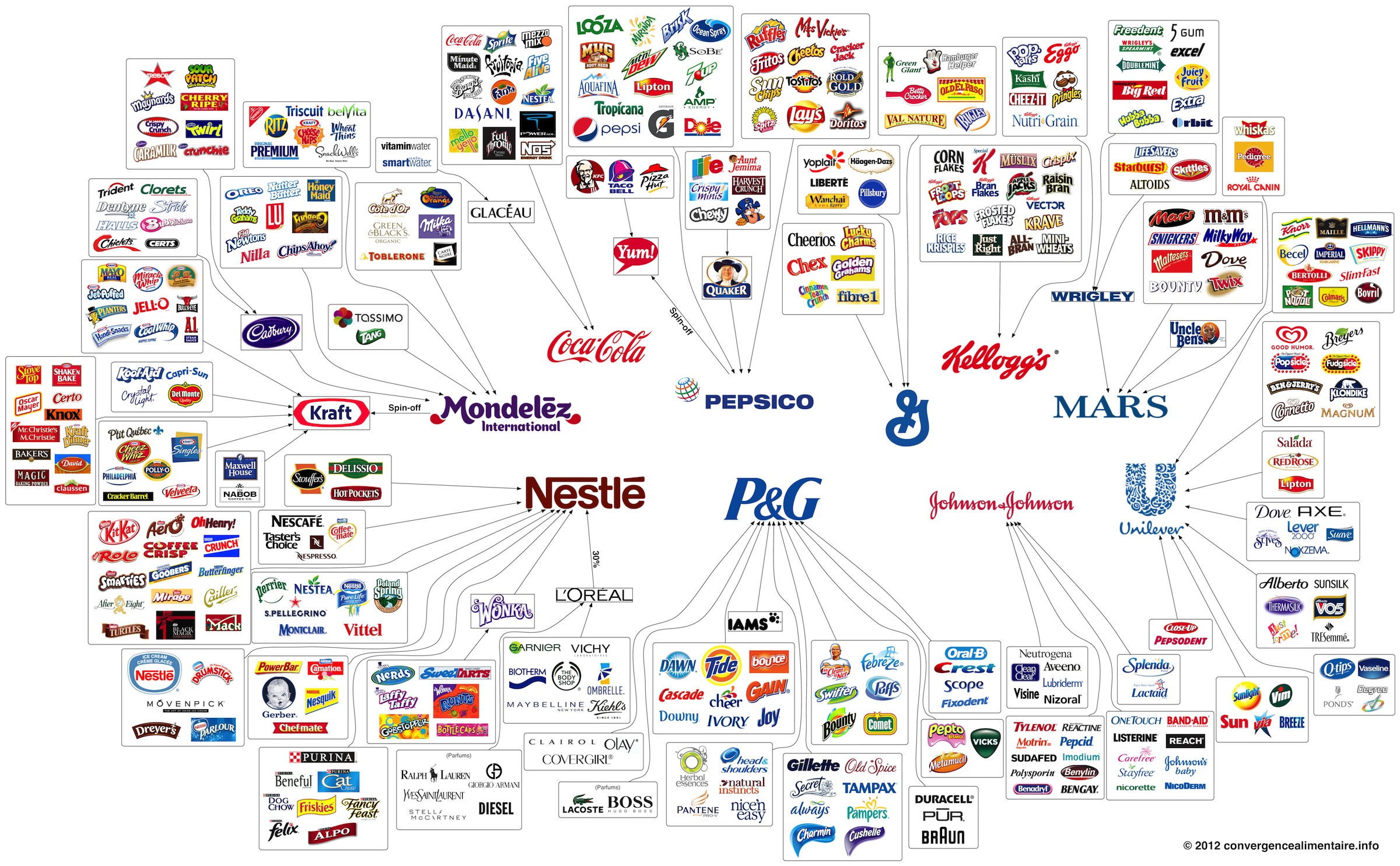
Our political system is tightly reined by wealthy companies. Our laws are heavily influenced by the financial preferences of these corporations. (Graph of the names and companies which control every aspect of our lives--all linked to the Bilderberg Group, which is entrenched in our politics: http://cloud.decryptedmatrix.com/live/wp-content/uploads/2012/06/Ultimate_Bilderberg_Flowchart_Connected_Politicians_Corporations.jpg) It should be known that many of the cosmetic, food, pesticide, and drug additives we use so liberally in the U.S. have been banned in most other first-world countries because they are so dangerous. Marijuana is illegal here not because it hurts users, because it lessens our reliance on some pharmaceuticals--and because its cousin, hemp, eases the monopoly on certain building and clothing materials. (And arguably, because marijuana encourages a different kind of thinking and a release of our egoistic vice-grip on reality as it is--the reality of this ridiculous system. If the issue was personal damages, then alcohol would also be illegal. In a country where we pride ourselves on our individual liberties, we cannot tell adults what they consume in their private lives.)

So what does all this have to do with the threat by people in so many states to secede from the union? I would hope it would be clear, by now. People are tired of being victims in their own country. People are tired of being slowly murdered by their medicine, their food, their banks, and their politicians--even if indirectly. People are tired of being forced to support companies which destroy our planet, abuse the animals we eat (http://www.farmsanctuary.org/learn/factory-farming/), and abuse the money of their consumers. People are tired of being arrested for practicing their constitutional rights. People are tired of paying for war. People are tired of being afraid. There have been plans for years to secede from the union with the intent of rebuilding while out from under this massive, oppressive thumb.
But this is where it gets complicated (hahaha.) No one person can speak for everyone else. Some people will jump on the Secession Bandwagon because they hate Obama (and a shocking number of people hate Obama for purely racist reasons, even if they are not aware of it themselves.) Some people will support secession because they think America is falling apart because of increasingly "tolerance" of homosexuality, religious freedom (including freedom to not partake in any religion), and racial mixing. What's important to note here, however, as that this is not everyone. People are supporting this for many different reasons.
Meanwhile, the media did not begin to highlight this movement until immediately after the 2012 elections, drawing attention not to the core of the movement, but to the population of racists within it. Trust me, this is not accidental. But the movement is not defined by the racism which exists in pockets of its population, just as Occupy Wall Street was not defined by the hateful extremists which cried out for the death of the rich. (God damn it, that was infuriating.) That kind of extremism is harmful to a cause, yes, but it is not the center of it.
I think it is safe to say that no state will actually secede. The driving force behind the threat is the last-ditch effort to grab the attention of our branches of government. "The people are mad," they cry. "Stop ignoring us. Stop forcing us into lifestyles of which we do not approve. Stop misrepresenting us. Stop destroying our planet. Stop seeking profit over people. Stop encouraging ignorance and disease. Stop tricking us out of our money. Stop dangling political puppets in our faces in an attempt to turn us against each other. Stop telling us that consuming will solve our problems. Stop lying. Stop bombing. Stop!"
For the record, I neither support nor ridicule the threats to secede. I feel things are too complicated to be so black and white, and I fear the backlash of those who ridicule the movement will separate the people, rather than uniting them against their abusive Corporate Government. (Rather than divide ourselves, I would suggest looking into this: http://www.represent.us/#video. Represent Us is championing The American Anti-Corruption Act, which "gets money out of politics, so the people can get back in." The following website explains the AACA: http://anticorruptionact.org/.) I also have no idea what the numbers are. I don't know how many people want secede because Obama is black, or how many want to secede because he signed the NDAA, or how many want to seceded for both reasons. From some perspectives, it won't matter. Common ground and wider understanding are what matter. Lincoln didn't abolish slavery strictly for one reason, either, but the eventually result, while not perfect, was absolutely necessary and extremely positive, wouldn't you agree?
Repost: Reconsidering Thanksgiving (and Columbus Day)
While it is true that for most Americans, Thanksgiving is a day of gratitude for the comforts and people in our lives—a celebration of diversity and of the tolerance therein—it is also true that for many remaining Native Americans, Thanksgiving is a day of mourning. Yes, there was a day in which the Wampanoag in the North east and the colonizers shared a harvest celebration. However, within fifty years of that feast, the Wampanoag were no longer a free people. The remaining Native Americans have been removed further and further from their resources and homelands. Their reservations are small, environmentally inhospitable to agriculture, and under constantly abuse. One-in-Three Native American women are raped by intruders who enter their reservation, commit the crime, and then flee. (See link: http://www.nytimes.com/2012/05/23/us/native-americans-struggle-with-high-rate-of-rape.html?pagewanted=all&_r=0.) As reservations are somewhat separate from federal law, it is difficult to prosecute non-native Americans who enter a reservation and commit a crime. Tribes are unprotected and their needs go unheeded, despite having been forced to live where they are in the first place. Children are taken from them by state child services for reasons which often cannot be fully explained (see link: http://www.npr.org/2011/10/25/141662357/incentives-and-cultural-bias-fuel-foster-system), further chipping away at the populations of their dwindling families.
For many Americans, the Natives are a distant memory from a biased and largely incorrect fifth grade history textbook. It’s important that while we enjoy our cozy homes, blessed family, and plentiful foods and comforts, we also take a moment to remember those who have suffered and continue to do so in the creation of the world in which we now live.
While we like to believe Christopher Columbus discovered America, this is wrong for multiple reasons. Most importantly, America was already fully populated by tens of millions of Natives. It was so heavily populated that it was experiencing issues with global warming, as so many trees had been utilized and so many fires were constantly being burned. It is also a false statement because Europeans and Nords had sailed to North America many times previously without having been able to domiante the local populations. Eventually, the occasional arrival of Europeans brought plagues to North America, and it was Smallpox which wiped out more than 20 million Natives. By the time Columbus arrived (and systematically murdered, enslaved, and raped the Native population with which he came into contact) most of the work had been done for him.
It’s also important to understand just how Europeans and Natives interacted. No one person can represent an entire population, and so not all settlers were murderous rapists. Colonials were often completely overwhelmed by the cleanliness, kindness, and beauty of the Native Peoples. Their “laws” and habits were so fantastic that there was a constant “problem” with colonials fleeing their territories to intermix with the Natives and live happily. Some tribes were so kind and welcoming that their populations became completely interbred with Europeans. Verrazzano, for example, was a sailor who brought a native upon his ship. He described him as being "as beautiful in stature and build as I can possibly describe." William Wood , a British fisherman, said the Natives of New England were "more amiable to behold, though dressed only in Adam's finery, than ... an English dandy in the newest fashion." (See book: http://books.google.com/books/about/1491.html?id=vSCra8jUI2EC)
Christpher Columbus provides perhaps the finest examples of the atrocities which have been carried out against all manner of Native peoples. Columbus came upon Haiti and, having recognized the presence of gold and of the people’s limited technology, immediately set about subjugating its people. He so thoroughly enslaved and destroyed the native Arawaks that:
So what of the Native Americans still lingering in North America? Many have given in and blended with a society which continues to destroy the environment originally taken from the indigenous peoples. There are many who can proudly cite their fractional connections with native tribes (for example, I have up to 1/16th Cherokee ancestry. It’s not even worth mentioning, really.) But for those who prefer to hold to tradition and remain separate from the society which so destroyed them in the first place, rights and protections are few and far between. So this Thanksgiving, remember what has happened to bring us to the state we are in today. Remember the “great men” who slaughtered and raped and enslaved their path across North America so that we could sit at a table of meats, breads, vegetables, casseroles, jellies, butter, and gravy. Remember the people who came before you. And of course, appreciate what you have, and know the great damages brought about by great greed.
To read a speech written by a descendent Wampanoag man Wamsutta James, see the following link: https://masbury.wordpress.com/2008/11/28/the-suppressed-thanksgiving-speech-of-wamsutta-james-wampanoag/. The speech was rejected by The Massachusetts Department of Commerce in 1970, as it was a historical recount of truth, rather than the complimentary boot-licking the state was looking to receive. Wamsutta refused to read a speech provided for him, and so he did not speak.
For many Americans, the Natives are a distant memory from a biased and largely incorrect fifth grade history textbook. It’s important that while we enjoy our cozy homes, blessed family, and plentiful foods and comforts, we also take a moment to remember those who have suffered and continue to do so in the creation of the world in which we now live.
While we like to believe Christopher Columbus discovered America, this is wrong for multiple reasons. Most importantly, America was already fully populated by tens of millions of Natives. It was so heavily populated that it was experiencing issues with global warming, as so many trees had been utilized and so many fires were constantly being burned. It is also a false statement because Europeans and Nords had sailed to North America many times previously without having been able to domiante the local populations. Eventually, the occasional arrival of Europeans brought plagues to North America, and it was Smallpox which wiped out more than 20 million Natives. By the time Columbus arrived (and systematically murdered, enslaved, and raped the Native population with which he came into contact) most of the work had been done for him.
It’s also important to understand just how Europeans and Natives interacted. No one person can represent an entire population, and so not all settlers were murderous rapists. Colonials were often completely overwhelmed by the cleanliness, kindness, and beauty of the Native Peoples. Their “laws” and habits were so fantastic that there was a constant “problem” with colonials fleeing their territories to intermix with the Natives and live happily. Some tribes were so kind and welcoming that their populations became completely interbred with Europeans. Verrazzano, for example, was a sailor who brought a native upon his ship. He described him as being "as beautiful in stature and build as I can possibly describe." William Wood , a British fisherman, said the Natives of New England were "more amiable to behold, though dressed only in Adam's finery, than ... an English dandy in the newest fashion." (See book: http://books.google.com/books/about/1491.html?id=vSCra8jUI2EC)
Christpher Columbus provides perhaps the finest examples of the atrocities which have been carried out against all manner of Native peoples. Columbus came upon Haiti and, having recognized the presence of gold and of the people’s limited technology, immediately set about subjugating its people. He so thoroughly enslaved and destroyed the native Arawaks that:
According to a letter written by Michele de Cuneo, before his first voyage had even reached Haiti in 1492, "Columbus was rewarding his lieutenants with native women to rape." Columbus wrote in 1500: "A hundred castellanoes are as easily obtained for a woman as for a farm, and it is very general and there are plenty of dealers who go about looking for girls; those from nine to ten are now in demand."When there were no more Arawaks to mine his gold for him–for they no longer existed–Columbus systematically depleted the Bahamas of their peoples for this task. Tens of thousands of slaves from the Bahamas were transported to Haiti, leaving the islands behind deserted. Peter Martyr reported in 1516: "Packed in below deck, with hatchways closed to prevent their escape, so many slaves died on the trip that a ship without a compass, chart, or guide, but only following the trail of dead Indians who had been thrown from the ships could find its way from the Bahamas to Hispaniola."
After the new batch of slaves died, Columbus depleted Puerto Rico, and then Cuba. When they had all succumbed, he turned his eyes to Africa, thus establishing the transatlantic slave trade and the concept of "race."
(See link: http://faceless39.hubpages.com/hub/Christopher-Columbus)
So what of the Native Americans still lingering in North America? Many have given in and blended with a society which continues to destroy the environment originally taken from the indigenous peoples. There are many who can proudly cite their fractional connections with native tribes (for example, I have up to 1/16th Cherokee ancestry. It’s not even worth mentioning, really.) But for those who prefer to hold to tradition and remain separate from the society which so destroyed them in the first place, rights and protections are few and far between. So this Thanksgiving, remember what has happened to bring us to the state we are in today. Remember the “great men” who slaughtered and raped and enslaved their path across North America so that we could sit at a table of meats, breads, vegetables, casseroles, jellies, butter, and gravy. Remember the people who came before you. And of course, appreciate what you have, and know the great damages brought about by great greed.
To read a speech written by a descendent Wampanoag man Wamsutta James, see the following link: https://masbury.wordpress.com/2008/11/28/the-suppressed-thanksgiving-speech-of-wamsutta-james-wampanoag/. The speech was rejected by The Massachusetts Department of Commerce in 1970, as it was a historical recount of truth, rather than the complimentary boot-licking the state was looking to receive. Wamsutta refused to read a speech provided for him, and so he did not speak.
Repost: Observations on Capitalism
Capitalism, like Communism, is inherently neither good nor bad. It is a tool which we utilize, and how we utilize it decides its worth. Unfortunately, as with many of our other tools (wealth, technology, self awareness), people are severely unprepared for dealing/living/working in such a system. Some of this unpreparedness has to do with the conscious evolution of our species, but a great deal of it is also linked to our massively underdeveloped (and tightly constrained) educational system. More still, how society raises us to feel about other living things greatly affects our sense of responsibility with people, nature, and society itself. We abuse our economic system (as we abuse wealth, technology, and our capabilities for self awareness & whether or not we strengthen said awareness.)
Therefore, we regulate our economic system, making it not true capitalism but a mixed market economy. People, in their constant abuse of wealth and self worth, see regulation as a threat to their ability to gain MORE MORE MORE, regardless of how impossible and damaging that constant gain is. (Quite literally, we have limited resources and limited labor, grand though both may be.) Meanwhile, much of our regulation is geared toward helping money grow as opposed to avoiding abuse. It's juuust enough to keep the rest of the country from flipping tables over how badly we've destroyed our environment; the damage we've caused to peoples in South America, Africa, and Asia; and the destruction we've brought upon our own values, physical health, and emotional health. We want things more desperately than we want health. We want convenience more desperately than we want peace. Arguably, we've done this to ourselves.
There is another factor, of course. We are carefully sculpted to think this way. After all, this behavior is most profitable for private businesses and for governments, alike. Private business has become so important that it has the same rights as living, breathing people. For example, human beings are losing the right to know what private businesses are feeding them. We're in a fight right now to require the labeling of GMOs, and Monsanto is spending millions of dollars to make sure the public doesn't know they're being killed by the company which feeds them and profits from their ignorance. There is no government effort to protect us, despite the regulation supposedly meant to keep this kind of greedy behavior from harming us. In order for the richest few to remain this way, we must be kept under tighter and tighter control. We must be raised to think it's okay to encourage our children to be violent, slutty, wasteful, and morbidly obese; because then we'll buy up all the military games, bratz dolls, cheetos, and (eventually) Hummers without bothering batting an eye. There's no economic need to instill other values in our children along the way. Thinking this way moves money along, and it supports the companies which support our politicians.
Most importantly, however, we must see how the cycle feeds back on itself. The reason we are kept in such a state is because it's not enough to maintain one's wealth. Once a person has grown accustomed to constant growth and wealth, it's never enough. This is the human weakness that encouraged regulation on Capitalism in the first place.
MORE MORE MORE. At the expense of all else. That is why we can't "handle" capitalism. Or communism. Or socialism. For various reasons, we can't handle freedom. We continue to elect assholes to make decisions for us, because we're raised to think only rigid, controlling assholes are the right kinds of people to be leaders. We do it to ourselves.
But do not confuse my hypothesis with hopelessness or pessimism. Rather, I am recognizing a core of the issue. Altering our values, our attitudes toward living things, and our attitudes toward cooperation within systems must become a top priority. (See article, "Cooperation Is a Key To Intelligence.")
In order to create better systems, we must become better people. It starts with us, as individuals. I have to make the decision for myself. I cannot make it for anyone else. I cannot force it on anyone. Trying to do so paints my intent in a negative light and destroys it. I can live the example and help to educate people. I can encourage.
So, arguing about whether any of these existing economic systems are good or bad is a losing battle, in my opinion. We have to make something sustainable. Something new. We have to live the lifestyle we want others to mirror. And we have to hold each other accountable. When Person A abuses his/her power and lessens the quality of life for Person B, we cannot just sit idly by, no matter who profits from Person A's behavior. Agreeing on these basic points is arguably several steps back from being able to point to an existing, fully developed economic system or budget plan, but we've been needing to go back to the drawing board for a while. We keep ignoring the root causes and focusing on the symptoms/effects of the disease.
Therefore, we regulate our economic system, making it not true capitalism but a mixed market economy. People, in their constant abuse of wealth and self worth, see regulation as a threat to their ability to gain MORE MORE MORE, regardless of how impossible and damaging that constant gain is. (Quite literally, we have limited resources and limited labor, grand though both may be.) Meanwhile, much of our regulation is geared toward helping money grow as opposed to avoiding abuse. It's juuust enough to keep the rest of the country from flipping tables over how badly we've destroyed our environment; the damage we've caused to peoples in South America, Africa, and Asia; and the destruction we've brought upon our own values, physical health, and emotional health. We want things more desperately than we want health. We want convenience more desperately than we want peace. Arguably, we've done this to ourselves.
 |
The Kayapo being expelled from their homes for the
construction of the Belo Monte Dam,
|
There is another factor, of course. We are carefully sculpted to think this way. After all, this behavior is most profitable for private businesses and for governments, alike. Private business has become so important that it has the same rights as living, breathing people. For example, human beings are losing the right to know what private businesses are feeding them. We're in a fight right now to require the labeling of GMOs, and Monsanto is spending millions of dollars to make sure the public doesn't know they're being killed by the company which feeds them and profits from their ignorance. There is no government effort to protect us, despite the regulation supposedly meant to keep this kind of greedy behavior from harming us. In order for the richest few to remain this way, we must be kept under tighter and tighter control. We must be raised to think it's okay to encourage our children to be violent, slutty, wasteful, and morbidly obese; because then we'll buy up all the military games, bratz dolls, cheetos, and (eventually) Hummers without bothering batting an eye. There's no economic need to instill other values in our children along the way. Thinking this way moves money along, and it supports the companies which support our politicians.
 |
| Amendment flier for California, 2012. |
Most importantly, however, we must see how the cycle feeds back on itself. The reason we are kept in such a state is because it's not enough to maintain one's wealth. Once a person has grown accustomed to constant growth and wealth, it's never enough. This is the human weakness that encouraged regulation on Capitalism in the first place.
MORE MORE MORE. At the expense of all else. That is why we can't "handle" capitalism. Or communism. Or socialism. For various reasons, we can't handle freedom. We continue to elect assholes to make decisions for us, because we're raised to think only rigid, controlling assholes are the right kinds of people to be leaders. We do it to ourselves.
But do not confuse my hypothesis with hopelessness or pessimism. Rather, I am recognizing a core of the issue. Altering our values, our attitudes toward living things, and our attitudes toward cooperation within systems must become a top priority. (See article, "Cooperation Is a Key To Intelligence.")
In order to create better systems, we must become better people. It starts with us, as individuals. I have to make the decision for myself. I cannot make it for anyone else. I cannot force it on anyone. Trying to do so paints my intent in a negative light and destroys it. I can live the example and help to educate people. I can encourage.
So, arguing about whether any of these existing economic systems are good or bad is a losing battle, in my opinion. We have to make something sustainable. Something new. We have to live the lifestyle we want others to mirror. And we have to hold each other accountable. When Person A abuses his/her power and lessens the quality of life for Person B, we cannot just sit idly by, no matter who profits from Person A's behavior. Agreeing on these basic points is arguably several steps back from being able to point to an existing, fully developed economic system or budget plan, but we've been needing to go back to the drawing board for a while. We keep ignoring the root causes and focusing on the symptoms/effects of the disease.
Friday, September 30, 2011
Personal Anecdotes Often Do Not Negate An Argument
Edit: Despite the work I put into wording this just so, it seems I didn't illustrate my purpose well enough, and I managed to offend someone very dear to me. Quite simply, this blog post aims to do the following:
- Assist fellow activists/conversation starters.
- Assist non-activist individuals trapped in the dramatic whirlwind of these conversations.
- Encourage all parties to recognize that their perspective, while important, may not embody the full "story." It's important to consider the other party's perspective, as well.
- Inform readers that very rarely does a personal anecdote amount to an effective argument. That does not make the anecdote unimportant. Anecdotes are necessary to share a perspective, and we should feel privileged to be given a glimpse into the other party's life. Generally speaking, however, anecdotes do not negate the argument of the other party (there are always exceptions, of course.)
I hope this clears up a few things. On to the post.
When voicing my opinion or sharing information regarding the state of the economy, medicine, industry, education, civil rights, workers' rights, or other present situation worthy of attention, I am met with many different reactions: some are very positive, some are inquisitive, some are disinterested and neutral, and some are flat out spiteful. Throughout this range (and inclusive of other reactions not listed because there are honestly too many to pinpoint each), there are two kinds of arguments I come upon more frequently than others, and they both involve an individual using their own experiences as proof that nothing is actually wrong. It should be said that these are broad generalizations based on my own experience, along with what I have read/heard/witnessed for many others. These two arguments can be very similar, and it may not be obvious why I have separated them in the first place. There tends to be a difference in the two viewpoints, however:
- The I've spent my entire life struggling and you don't hear me complaining argument, and
- The I've worked hard and made ends meet, so people need to take responsibility argument.
Person #1 is often quite angry. He/she has indeed worked incredibly hard under inhumane conditions. Perhaps they served in the military and experienced life-altering situations, or worked two or three jobs while fitting as many college classes in as possible. Perhaps they have children, as well. Perhaps their families were a great drain on them emotionally, financially, and opportunistically. Or, perhaps all of these apply to this person. Person #1 is upset that they had to deal with so much in order to maintain some livable situation, and other people aren't as willing to do so.
Person #1 fails to realize that people fighting for fair wages, fair hours, fair and cheaper school opportunities, and all the rest, do not think for a moment that Person #1 does not deserve everything they have. Quite the opposite, in fact. Person #1 deserves a great deal more. In our modern society, with money and food and resources aplenty, no one should have to deal with all of those things just to survive. If you have, I have a great respect for you and am so sorry that life has been so difficult. Your government should provide far more opportunities for you. I fight the idea that I should have to juggle a debt-bloated college education, varying part time jobs with no benefits and minimum wage income, and a system consistently standing up for the demands of Big Business while stepping all over the workers who allow business to function at all. Yes, people do it. That doesn't make it okay. That's the whole point, really. Do we really want our children and grandchildren to have to use these personal anecdotes as the measurement of their worth and success? Aren't we supposed to want better for future generations? Isn't that the point--to be constantly bettering ourselves and our society?
Person #2 is more apt to assume that the people who can't "make it work" simply aren't doing it right, and/or they're trying to milk the system while avoiding responsibility/hard work. (Person 1 and 2 may overlap on this subject, but I have separated them for this writing.) These individuals also use their personal anecdotes to show how success (however you define it) is possible.
Person #2 also deserves everything he/she has drawn together for him/herself. This is where the anecdotes serve another purpose, however: just because you did it, doesn't mean everyone else can, too. My fiance recently worded it pretty nicely when she said, "For every one person who makes the system work for themselves, there's a dozen people who abuse rather than trying, and hundreds more who simply cannot, for one reason or another." This isn't about the people who did it vs. the people who can't. It's about the system which makes it so difficult for so many who simply are in wholly different situations and therefore do not have the same opportunities.
Many of these individuals want nothing more than to grab that full time job and start putting away to Social Security. They want to take out a loan for a new car and build credit. They want to go to school and better themselves and their employability. But for whatever reason, they are unable to get that full time job, or they can't afford payments on a new car, or their credit won't allow for the purchase to be realistic for them in the first place, or their schedule and dismal future don't place a college education within their reach. Maybe they made a few mistakes. Still, they deserve the chance to make a decent living and get a decent education. After all, a mistake from which we've learned shouldn't wreck the rest of our lives; and the more educated we all are, the better society would be. Or maybe they've spent their entire lives in a poor situation with very poor opportunities. It's easy to forget that every little detail about our childhood leads up to the place we are in today, and not only do many people grow up in low-wage households, but many children grow up in abusive, oppressive households. These individuals are not doomed to fail, but are far more likely to.
If you find yourself in an argument regarding these issues, regardless of the side you're on, please stop and consider these things. Nothing is ever as simple as it seems, and it is very easy to condemn a person while knowing nothing about them or what brought them to the current stage of their life. Just because Person #1 has had to fight so hard, doesn't mean he/she should have been forced to. Just because Person #2 was able to make it work, doesn't mean it's a possibility for everyone else. Just because Person #1 or #2 is arguing that you're not working hard enough, that doesn't mean he/she deserves to be disrespected. Just because you can't make it work, doesn't mean it's unworkable. We live our lives and so are limited to our immediate perspectives, but there's always more.
Personally, I have to make sure I choose my wording a little more carefully to avoid excluding or stepping on some folks/groups. For example, I should point out that anecdotes are not useless. However, an individual's personal anecdote often does not form a complete argument. It may have a good point, but that doesn't make it a complete argument. A single anecdote is only useful to that single set of circumstances--its logic often cannot be applied to other situations. (This is not all-inclusive, of course. There are always exceptions to everything.) Huge groups of anecdotes start to form a visible trend, and statistics can be very useful.
What I encourage people to avoid is, "Here is the problem, and here is what I did for that problem. Therefore my solution also works for you, and if it doesn't work, you're doing it wrong/you don't want it enough/you don't deserve it."
Edit: Which also means to avoid, "It's impossible to make anything work, why even try?"
Both of those are incorrect assumptions. They exclude both people and opportunities, and they limit the individual.
Subscribe to:
Posts (Atom)