Showing posts with label corporations. Show all posts

Wednesday, January 2, 2013

Messages To A Friend: Breast Cancer

I recently had a couple of very productive conversations with some friends on Facebook. It's always a little refreshing when two folks can disagree on something but still understand and appreciate each other's perspectives. These conversations ended up getting pretty verbose, and in one of them I put a good deal of effort into explaining why I post the things that I do (on Facebook and in this blog.)

I had posted a small piece of commentary about breast cancer:

Little rant, forgive me: fighting breast cancer isn't about "saving the tatas." It's not about breasts. It's about beating cancer. Sexualizing the often deadly effects of cancer isn't cool or funny.

I don't support those pink ribbons, either, I'm sorry to say. Wanna help find a cure for cancer? Research the people and places that aren't strictly funded by Big Pharma. Wanna protect yourself and your family? Pay attention to your health. Focus on nutrition, physical activity, and severely reducing stress. We focus on a cure, when we won't even pay attention to the causes. Quite the opposite. We pretend like we don't know what causes it, because is cheaper than treatment. (Treatment, not cures. They don't provide a cure, and I don't believe they really want to, considering all the information they ignore and the costs you must pay to try and survive. Not to mention, medically suggested treatment is as damaging on good cells as bad, and makes it easier for cancer to return.)

...Woo. End rant.


Later, my friend replied to the post. While I told this friend that I would be sharing my replies to him on my blog, I do not want to post his words or name here, as I didn't ask his permission. Basically, he told me that while he sees my point, my post lacked taste and tact, considering how very personal the subject is and how it is not my place to tell people how to act when facing such extreme obstacles. He shared a bit of his personal experiences with me, as well. I love this man, and am so glad he did this. We still disagree on part of this, but we also agree on a great deal.

The following replies (grouped together) attempt to explain why I disagree with the idea of my post being in poor taste, why I (generally) think it's more important to educate than to sugar-coat, and why I felt it was so important to explain this to him in the first place. They also point out that I do agree that I sometimes come off as "pushy" rather than just "encouragig," and that I am actively working to curtail that emotional habit. I'm sharing it all here because I've had this discussion (more or less) with a few people already, and I'd like to have something to show people in the future. Point being, I promise I'm not an asshole! It's so easy for people to assume that the guy saying the stuff they don't wanna hear is a jerk, after all.

Alright, here goes:

For the most part, I agree with your comment. I'm going to break down my reactions to it. Be patient with me, lol.

1) I gather that you assume I haven't had much experience with cancer, particularly breast cancer. (At least, this is what I read in your comment. If you didn't intend this, I apologize ahead of time.) In the US, approximately 1 in every 300 people will get or already has cancer (according to this graph I pulled up of the top 10 countries with worst cancer rates.) Point being, it's very likely that everyone has knows someone who has/has had/has died of cancer. So I don't think for a moment that I'm in a special bubble of cancer experience, believe me. Still, I've lost multiple family members and very close friends to cancer. My aunt, luckily, survived the cancer in her breast. Since I started my hormone treatment, certain cancer risks have increased, and I've done a good deal of research since I found out. I don't speak with any sort of ignorance of the ordeals and incomprehensible fear and suffering that cancer patients must deal with. My absolute worst medical fear is cancer. I agree, cancer is no small matter. I take it *extremely* seriously. I take it *so* seriously that:

2) I risk potentially bothering people I care about in order to try to bring these things to their attention. I do not, however, point it out to people individually, as my goal is never to upset anyone. I'm inclusive (lots of "we" and "us.") But in the end, attempting to plant even the smallest seedling in someone's mind about the injustices and abuses around them (involving things like the terrible state of healthcare in our country, hence why I stress how important preventative medicine is, and how we've been couched to mock its very consideration) is far more important than making sure no one's ever made uncomfortable by the truth. I do NOT condone specifically seeking to make people uncomfortable. That is VERY IMPORTANT. I do my best to avoid it. Clearly, however, I'm not perfect at avoiding that.

3) You suggest I approach the subject from another angle (disagreeing with the pink ribbon campaign, disliking the silly and disrespectful Save The Tatas slogan, greedy marketing, etc.) I want to point out, here, that I *do* those things. I just don't do them in a way you approve of. I say that I don't like the ribbons, I say that slogan is ridiculous, and I blame "Big Pharma" for limiting our options to *their* options. That's ribbons, slogans, and marketing. But I can, however, see how my wording may have caused blanket misunderstands, rather than encouraged reflection. Let me clarify one:

4) I do not condemn pharmaceuticals, but it's not strange for people to assume that I do. Similarly, I do not hate money or people who abuse it, but some assume I do. It's not unusual for people to assume disliking an extreme of something means one must dislike the whole of that thing, and I understand why. It's a sort of hyperbole fallacy. (In fact, some folks assume this of themselves, and are too quick to hate the whole of something when they really only disapprove of a prevalent extreme.) Let me explain myself. I don't think our modern capabilities with medicine are all horrible. I get bi-weekly injections of an expensive drug, and probably will for the rest of my life. Medicines and treatments are one of our most amazing human accomplishments, and people are entitled to seeking whatever medicines they want. I don't at all mean to make you think I think otherwise. It's the control, greed, and ramifications of Big Pharma that I tend to rant about. I use that term for a reason. "Big Pharma" doesn't reference all of "modern medicine." It specifies the grouped corporate entity that controls our health and the legislation around it. It dips itself into our cultural sense of morality, our politics, our goods and services, our education, our economy, and pretty much everything about our daily lives. I'm honestly sorry, I do not feel wrong for openly expressing my dislike for that. But I will defend our amazing medical science up and down, and defend people's right to seek whatever medical goals/treatments/pathways they want.

5) Yes, I get pointed and instructional when I go off on rants. THAT'S where I definitely agree with you the most. Of course, I called it a rant for a reason. It was exactly that. It was not the most considerate thing I've ever written. Far from it. I also never told readers it was anything other than a rant. It was a mix of frustration and desperation. "Please, God damnit, pay attention to this, ugh." You got me, there, man, no joke.

6) And this is where the last two years of my own personal growth comes into play. This is what I really want to make sure you understand about me, because I care very much about you and our friendship, and I don't want you to think I'm a terrible person, lol. I do not blame or hate anyone for whatever situation they're in or whatever kind of person they are. That means that when I complain about the Papa John's CEO, or when I rage about corporate money in politics, or when I urge people to pay attention to their health and stop supporting harmful companies and harmful medicine, or when I groan about religious extremists making progress so difficult... I never blame or hate the people--neither the people creating the issues, nor the people unknowingly perpetuating them. We all think we're right. We all think we're doing what we're supposed to. We feel the way we do based on our past experiences, the environment we were born into, the people who left their marks on us as we developed, our amount and type of childhood stimulation, our social experiences, blah blah blah. And beneath all of that, we're still limited by our biological structure. Our brains and chemicals work a certain way. Our instincts reveal themselves at certain times. I don't blame or hate anyone. And therefore I dedicate myself to just trying to plant those seedlings here and there. I encourage people to stop and think. Not to judge themselves. But to THINK about themselves.

In all honestly, I want people to love themselves, and to love others.

But I'm a human being. I get frustrated. I get tired. Some things trigger a stronger emotional response than others. And in the end, I'm just as flawed as everyone else in my own ways, and so one could argue I'm wasting my time and annoying some others, so why bother?
Because I take it seriously, and it's important to me to try to help improve... *everything.*

...Woo!

I know that was long and man I am sorry for that. We don't talk very often and I basically just described how my brain works, so it required a lot of words, lol. I just went through and reread it to edit typos and whatnot, and to be honest it expresses my intentions so accurately that I may paste it into my blog to explain myself to other readers. Thank you for confronting me with this, [name removed for privacy]. It has made me think about how I express my concerns.

I don't expect you to agree with me on everything--or even anything. There have always been things on which we've disagreed, and it's never harmed our friendship, so I'm not worried about that. I just don't want you to think I'm a douchebag.

*******


Sometimes I can come across as very "glass half empty," but that's not my intent. It's mostly just a result of the constant bombardment of bad stuff. It's a big process, jumping into political, civil, and social activism. It's another huge process when one decides to focus on self betterment and introspection. I may not always go about it the best way, but it's not easy to do, regardless. It's a lot to take in, a lot to think about, and a lot to deal with. There's SO MUCH STUFF going on.

So, here's the best way I can summarize it. The internet is a huge part of my "world input" and is where I return to verbalize things I've come across and/or things I've learned. (As you said, sort of my unloading zone.) I don't live on it. My actual life is spent doing everything I can to be a positive example for everyone I come across. I want to have lots of info and perspectives, and I want to encourage the best in people. As I get so much of my outside input from the internet, however, it's also where I'll tend to be when I get on a tangent. Presently, at my age and at the current state of society and my place within it, I come across far more negative things than positive things, so a good deal of what will nag at me enough to share is negative. Also, at my age and place in society, I generally feel very trapped--like I'm constantly working to retain myself and my physical and mental health, while the world around me does everything it can to take that from me. From the foods I eat, to the medicine at my disposal, to the kind of cruelty and noise and flashing screens that plague us and stress us every day. I work to be happy and peaceful within myself, to improve the world by improving myself and encouraging it in others by setting a good example. You know. "Lead by doing," so to speak.

But as we know, I'm human and can get wrapped up in the problems. Luckily, I have friends like you.

Trust me, I'm pretty confident in the positive possibilities of the world.

I recalled after I sent my last PM that I had an event/epiphany I'd wanted to share with you, to help illustrate my focus on truth vs comfort.

Last year Brittany spent a lot of time in and out of the hospital. Long story short, she was diagnosed with Sickle Cell Anemia. Quite suddenly, we had to face the very real possibility that her life would decline very rapidly, and face the reality that it was very unlikely that she'd live past 40. That was the hardest week of my life. We learned a great deal about the disease (though we certainly weren't ignorant of it beforehand.) I also learned about how ignorance perpetuates the disease.

This is where I will draw a VERY limited comparison between people dealing with cancer and people dealing with sickle cell, to use as an example. The reason why will come later. Cancer patients can survive and recover (though recurrence is common and many statistics cut their information at "recurring within 5 years"), while sickle cell patients can in fact make it into adulthood. For the most part, however, cancer is deadly with our current treatments, and usually sickle cell patients never survive beyond late childhood. No preventative care can guarantee safety from cancer (though the foods we consume, activities in which we partake, pollutants around us, and other factors can severely reduce/increase our likelihood of getting it); and at the same time, someone is either born with sickle cell or they're not (making abstinence the only surefire way to keep from spreading it to your potential offspring.)

I'm sharing all this with you so you'll understand the situation before I continue with this: while facing the promise of excruciating episodes of pain (called "pain crises"), long expensive hospital visits, and the eventual (youthful) loss of my fiance, I also came to realize how education and selflessness could prevent future generations from suffering with all that. Early screenings on pregnant mothers and newborn babies, knowing one's family medical history, etc etc. Learning about this stuff was hard, at the time, especially because it was all "too late," anyway, and the subject itself was very hard to think about.

But we needed to learn about it, anyway.

And when eventually we were told that she didn't actually have Sickle Cell (but carried it), we could then accept the lessons learned and try to educate others about it. It's still a very personal subject. And if I had lost Brittany, it would be even more difficult.

But I'm aware that just because I don't want to hear something, that doesn't make that thing untrue or unacceptable.

As we have also both discussed, however the methods for educating are important to consider. It's easy to get desperate when I watch sugar-coated methods get stomped on, laughed at, snubbed, or overtaken. Plus, all the carefulness in the world doesn't mean the message won't be misconstrued, still, or someone won't be *particularly* sensitive. I still work to keep in mind that "a spoon full of sugar," etc. After all, I don't wanna drive anyone away, and I don't want anyone to be miserable.

Sunday, December 23, 2012

Avoiding the Trap of Logical Fallacies While Fighting the Good Fight.

Lately I feel as though a part of my personality of which I have been ashamed in the past has matured and morphed (through no small effort) into something far more useful and worthwhile. Much of my childhood and young adulthood was experienced through very judgmental eyes. It was never enough just to experience the world around me; I had to have an opinion on it! In fact I would argue that constantly thinking and branching into dozens of possible reactions/happenings/sources/explanations has kept me from truly focusing on the matter at hand. I consider myself to have an overly active (and often uselessly analytical) mind, with perhaps a dash of ADD. I wouldn't be surprised if this is why it's so hard for me to remember anything.

I have a reason for sharing this somewhat troublesome self discovery, of course. Coinciding with my “adult” efforts to curtail my judgmental personality—and therefore be a more peaceful and likable person—is a growing desire to see situations from as many perspectives as possible. While this often results in seeking a highly objective perspective (which really sounds too oxymoronic to be used accurately), it also leads to playing the part of the Devil's advocate from time to time. I like to think that what was once a knee-jerk reaction to what I found to be unpleasant behavioral characteristics has become a permanent, empathetic sociological and/or psychological study. (Side note: I find it's harder to hate people when you can see their perspective, no matter how you may disagree with their behavior; that is a very freeing state of mind, I must say.) None of this is to say that I don't fall back into my old judgments, of course. I am a human being with much to learn and experience, after all.

I have, however, noticed a great deal about human behavior.

That having been said, I'd like to talk for a moment about the kind of thinking that I've witnessed in the last year or so of activism and really paying attention to the world around me. This will come in sections as a series of updates to this first post, as it turns out I have a lot more to say than I had originally thought (now that I've started writing and am returning to this paragraph some time later to make this addendum.)

I'd like to preface this post with the following: I make these blog posts to share my thoughts, in the hopes that it will serve others in some way. I know that I “use my words well,” and that my obsessive desire to express myself as clearly as possible may in fact help clarify some things for some people who find themselves perplexed by or perhaps even unaware of some of the behaviors around them. Perhaps readers will learn something about themselves. It's certainly been an enlightening experience for me. Understanding how and why we behave the way we do is often more important than just the behavior itself. I sometimes think about this not because I want to point out people's mistakes, but because I want to be helpful. I understand perfectly well that can be hard to believe, and I also understand just why that is. Knowing that, however, won't stop me from trying.

The subject of this “discussion” is the common use of logical fallacies to form arguments or even whole philosophies. I could spend days dredging up every single flawed argument I've heard in just the last few months, so I'll likely stick with those which have stood at the most and therefore come to mind most readily. I'd also like to add that I don't actually partake in these arguments very often. I really dislike confrontation. That isn't to say I'm particularly afraid of being wrong (though no one likes that feeling.) Rather, the confrontation itself makes me extremely anxious, as though I'm at the risk of being physically attacked at any given moment. I'd need a whole other blog post (or two) to explain from where my general anxiety stems. I'm pretty familiar with it (thanks a lot, Childhood Repercussions.)

  • The Slippery Slope Argument, in which one asserts that allowing one thing to happen will inevitably and unavoidably lead to another, previously unforeseen result, and therefore that first thing must not be allowed. This is both fully self explainable and worthy of an entire blog post in and of itself. Simply put, the use of this fallacy requires one to draw a number of assumptions—assumptions which I have found to be based more out of personal fear than any real fact. Now that their fears are apparently right at the back door, that fear rules the rest of the conversation. There can be no focus on how far from reality their argument has been taken. The only focus, now, is the supposedly imminent danger brought about by the idea in the first place. The most obvious example of this fallacy at work is within the gay marriage debate. A broadened definition of the concept of “marriage” clearly leads to bestiality and, eventually, legal marriage between species. This must be true, despite the fact that those two fears have nothing to do with the matter at hand: the fact that two consenting human adult homosexuals want to have the same legal and social rights as consenting human adult heterosexuals. The leap to bestiality has absolutely no basis in the reality of the original argument, but that Slippery Slope argument consistently stops progress on the discussion as though it actually means anything.

    Not to mention the fact that this argument assumes that every possible idea/demand that every member of the public could ever possible conjure up must immediately be accepted by the law, and that there's no possible way such a legislative decision might be avoided do to its complete illegitimacy.

  • The Strawman Argument, in which someone's argument is misrepresented in order to make it easier to attack them. I see this constantly. Common examples include the belief that wanting universal healthcare for all makes you an democracy-hating communist/socialist; the belief that women who speak out against misogyny are men-hating feminists (helping to create the resultant belief that “feminism” has a direct correlation with “hating men,” and thereby producing the “straw-feminist”); and the belief that those who speak out against the present plutocratic state of America (protesting the abuse of resources and privileges made by the wealthy both in terms of economic and government affairs) are either too lazy/unmotivated to work hard enough to earn true (i.e. monetary) success, or hate capitalism and money and therefore probably America (or all of these things, simultaneously.)

    At the same time, I also have seen—and have personally participated in—the reverse of that last fallacious argument. It's so easy to assume everyone who speaks out against public spending, true religious freedom, or sacrificing personal luxuries for the sake of making the world a better place (e.g. reducing/eliminating pollution, reducing material waste, preserving our resources, protecting other species, respecting other species, etc) feels that way for purely selfish, possibly even vindictive reasons, and that they are therefore bad, heartless people. It's easy to pigeonhole them into an inaccurate caricature and hate them.

    But if we consider the perspective of the person trying to help free the world from powerful corporations, of the person trying to awaken the public to sexism in what is its most popular and institutionalized form at the present, and of the person trying to encourage more effort be exerted by everyone in order to be less of a constant cancer on the Earth (rather than instantly writing them off and assuming they have no idea what they're talking about or specifically want to hurt you), then we may just be able to fix some of our problems. After all, things have only continued to get worse with our current way of doing things. Trying something else, *gasp!* may actually be a pretty good idea.

    Meanwhile, activists can't fall back on hating those who don't believe them. I've spoken extensively on the need to forgive and empathize, and to consider the preceding lifetime of every individual presently participating in these global conversations. Everyone feels the way they do for a reason. When we take the time to understand those reasons, we can then avoid boiling a whole person with a whole history which has made him who he is today, down into a simplified and hopeless strawman—and nothing more.

  • The Tu Quoque Argument (Latin for "You, also"), in which Person A avoids facing criticism provided by Person B by pointing out how Person B has made the same mistake(s) in the past. An appeal to hypocrisy should not be allowed to derail a conversation. Just because both (or all) parties have fallen into behaviors against which they are presently speaking out, that does not make those behaviors any less acceptable. Equal guilt doesn't negate the act itself. I saw an example of this very early on in the Occupy movement, when onlookers, news anchors, pundits, and internet comments appeared to take great joy in pointing out that so many of the folks protesting corporate greed and blind consumerism were utilizing the tools purchased in that same corporate environment.

    Separately, there are actually three things wrong with that, however. The most obvious issue is the Tu Quoque Fallacy at work, which I have already explained. Another issue is the assumption that buying goods is itself a hypocritical act in that particular situation (which in a way is the Strawman Fallacy at work again, simplifying the demands and rallies of the masses to a simple “owning stuff and having money is bad!”) A third issue is the assumption that it is a) viable to avoid all of these products by also assuming there are comparable alternatives, and also b) hypocritical to use the devices of the “machine” in order to “get back at it.” In a world where instantly worldwide digital communication is often a person's only security against irreparable police brutality and “cover-ups,” there are literally no other options but to use these tools.

  • The Black-or-White Argument, in which someone creates and/or defends the illusion that there are only two possible solutions (or sides) to a given problem. Sometimes this is used to increase his/her chances of successfully “winning” the debate. It misleads those trying to partake, and suppresses what might otherwise have been a rational appeal to other circumstances, perspectives, variables, etc. Sometimes it's interesting to see how eager people are to limit themselves in this way, particularly when the only two sides/solutions they can see fail to serve them in any way. For many, there are only two options: Materialism of religion (which for some boils down to Science or Not Science); economic success or a failed life; Capitalism or Dictatorship (as communism and socialism are often perceived as forms of absolute control, and therefore little more than a “group dictatorship.”)

    It doesn't occur to us to consider that maybe something that doesn't presently fit most obviously with our individual view of science can in fact be “scientific.” It doesn't occur to us that there may still be things beyond our current comprehension, or at the very least, outside of our current pool of ideas. It doesn't occur to us that we can be more happy with less, if we value quality over quantity. It doesn't occur to us that money is still just a tool, and therefore we control it, and therefore we can do whatever we want to with it, and so are not limited to just the (failed) attempts at a long term, stable economy thus far attempted by mankind. We limit ourselves, and harm ourselves in so doing.

  • The Anecdotal Argument, which I have discussed at length in a previous post, recently reposted here: Personal Anecdotes Often Do Not Negate an Argument.

    I'd like to add, here, that I have another example for the Anecdotal Argument that I did not mention in that blog post, and that is the assumption that because someone has not personally experienced something, it is therefore impossible. I was involved with (but mostly witnessed) a discussion within a group regarding bringing barter and trade systems back into local communities, rather than relying entirely on currencies. An individual assumed that because he personally could not recall a time in which people were satisfied with a good deed without monetary repayment (which he later realized was entirely untrue), he assumed therefore that deeds would only be done if money was promised in return, regardless of the necessity of the deed. This ignored the fact that with all of the people, labor, and resources available to a community, and with all needs met, there's little reason that a well structured community of empathetic individuals would be unable to function effectively and assist those in need. People assume that it's money that drives all good deeds, not merely because it's the right thing to do and they are more than capable of doing it.

  • The Bandwagon Argument, in which it is assumed that popularity makes something true, as though an idea's popularity automatically makes that argument more valid. (It is at times very similar to the Appeal to Authority fallacy, as we will notice.) I see this most recently in the form of quotes from famous political, social, and religious figures/texts. This is not to say that using a quote or reference from a reputable source is wrong. It also doesn't mean that it's wrong to share ideas or sources of inspiration via quotes. Not at all. When we have looked long and hard at an issue and find that a quote from a related, reputable source happens to speak this idea very well, that quote can be a very useful tool. However, simply relying on these quotes to decide an entire ideology, make whole decisions, or sway masses of people is not at all an intelligent way to solve problems or sculpt ones own philosophies. Just because someone says something well doesn't mean what they said was accurate, and it doesn't even mean that their words apply to the situation at hand. It seems to me that we rely on such quotes too often, rather than having meaningful discussions.

    I'd like to stress one last time that there is nothing wrong with using quotes. Sometimes someone else says something we feel/think very poignantly, after all, and sharing a quote from a respectable source can really help make people think twice about the validity of their stance. People must always think for themselves, however. Quotes do not “win” an argument.

  • The Special Pleading Argument, in which the rules/guideposts of someone's argument constantly change in order to work around and therefore avoid any proof that is placed in the way of their reasoning. (At times similar to the Texas Sharpshooter fallacy.) I see this put into play all the time. While everyone uses fallacious thinking at some point in their lives, the Special Pleading fallacy is one which I would assume is particularly common for us. After all, we hate to be wrong.

    The most obvious and immediate example I have for this involves arguments in which religion is used as a “reason” for someone's decisions and/or morals. It's actually a comical use of the fallacy, as the bible and other Christian works are so inclusively and exclusively contradictory that someone could go 'round and 'round a subject forever using excerpts to “prove” how something is right or wrong. Jesus said to love thy neighbor, to turn the other cheek, and not to condemn others to hell. That is what is expected of others when dealing with the speaker. But when it's time for the speaker to offer the same thoughtful self control, then it's time for “the bible says homosexuality is a sin,” or “it's my duty as a Christian to try to convert nonbelievers or inform sinners,” or “God says to destroy my non-christian neighbor, take his wife, and murder his children and livestock.” (Actually that last one isn't very popular, and I find that hilarious.)


There are so many more fallacies to discuss, but this has taken forever to write already and the ones listed above are the most obvious to me at the moment. I encourage everyone to take a look at this list of logical fallacies and to consider the ways in which you or people around you have relied on them in the past. (For an even longer list, check out this link.)Take care not to assume everything is a fallacy, of course. The goal is to learn, not to flay ourselves or others.

"Honorary mention" goes to the Argumentum ad Logicam, or "The Fallacy" Fallacy, in which one assumes that because a fallacy has been made, the entire argument is incorrect. (This is similar both to the Tu Quoque [above] and False Analogy fallacies [in which someone uses an analogy as proof of something, rather than as an illustration of something.]) I see this utilized most commonly when someone is searching for a reason to no longer have to absorb information which goes against the grain of his/her own beliefs, and so uses a person's bad choice of words or bad argument as a reason to ignore the truth.

I find it to be closely linked to a fallacious appeal to intelligence, in which a speaker might say "obviously this is the case," or "anyone can see that such-and-such is true." In making such a statement, the speaker urges listeners to assume intelligent people would have "gotten it," and because they may have thought otherwise, they must not be intelligent enough to "get it." This one is extremely common.

But please, don't abuse what you think you know about fallacies in order to stop listening to others, and don't judge yourself too harshly. It's all a learning process.

Tuesday, December 4, 2012

Repost: The Move to Secede (It's not as simple as you think)

Recently there's been a little uproar about the move of several states (proposed by citizens, not the state legislature, of course) to secede from the Union. It's easy to wag our fingers at these people, as this became public information in the media immediately after Barack Obama was elected for a second term. However, this is not news. That is, the threat to secede has been working its way to a head for years, and not necessarily for reasons you may be thinking. This blog post is not meant to as a cry of support for these threats, but as an attempt to help folks understand the movement a little more accurately.

Over the past year or so, I've been exploring numerous websites discussing dirty financial and political dealings between America and a host of Asian, European, and Middle Eastern nations for many decades (most of what I've read revolved around our dealings with China and Japan, but that limitation is likely due to my sources.) There has been so much information, and combined with the loose research I've done into other scandalous activities (wars, industrialization of medicine, control of education, suppression of energy technology, etc.) I can't even begin to regurgitate it here. Know simply that we owe many nations a great deal of money. We are refusing to provide government bonds for gold which we took under false pretenses. Individuals seeking to utilize the bonds they were given are being arrested for doing so, in part because the notes they have were purposefully falsified just in case they were ever "cashed out." Our underhanded treatment of other countries is reflected our treatment of U.S. citizens, most certainly.

In the mean time, we are losing our ability pursue life, liberty, and happiness. I mean this quite literally. In a basic hierarchy of needs, we must have food, water, and shelter before we can begin growing mentally and emotionally. When the masses are too busy trying to find employment, afford terrible food, and avoid a lifetime of medical debt, they don't have the time or the will (or, usually, the education) to seek to improve themselves--as individuals or as a society. Enlightenment of any kind is unattainable when our most basic needs are not met. Our brains don't function as well and our bodies grow ill and weak. Here are the ways in which America keeps its citizens from those three "God-given" rights:
  • The food (and its production methods) provided by our most powerful agricultural companies are harmful not only to us, but to the environment. When individuals try to fight back, these companies actually have the rights of the people reduced. (http://www.dailyfinance.com/2010/02/04/monsanto-the-evil-corporation-in-your-refrigerator/)
  • The medicine provided to us is controlled by pharmaceutical companies which are far more interested in long term financial gain than in actual cures. We create treatments, not cures. We do not remove the causes, but deal with the symptoms. Rather than fix our food and our living conditions, we create a campaign to make diabetes a "livable condition." We prepare to have a population in which 50% of adults are diabetic by 2020, rather than working to avoid it (http://abcnews.go.com/Health/Diabetes/diabetes-half-us-adults-risk-2020-unitedhealth-group/story?id=12238602). We treat our diseases and ailments like vague, unavoidable instances of misfortune; while our poisoned society, poisoned food, poisoned medicine, and negative (poisoned) psyche makes us far more susceptible to things like heart disease, cancer, autism, etc. Don't buy Komen's pink ribbons. They are not creating cures. (http://www.nakedcapitalism.com/2012/09/the-drugs-dont-work-how-the-medical-industrial-complex-systematically-suppresses-negative-studies.html)
  • Supplements are not properly regulated, and therefore the ratios provided are often ineffective. The food, supplement, and nutritional allowances provided by the Food And Drug Administration are often false, if not specifically misleading and dangerous (and are made with the specific intent of encouraging The People to continue buying into entities like Big Agri and Big Pharma.) In part because of this, the use of supplements is mocked by the media and the FDA. (http://relivecorp.wordpress.com/2010/06/05/fda-suppression-of-truthful-health-claims-for-nutritional-ingredients-and-supplements-is-destroying-our-future/)
  • Our energy is provided by a small collection of companies (energy which is required for us to live well and therefore should be a right, not a commodity) which provide us with old and earth-damaging technologies, while other countries are implementing far more wide-scale alternative energy solutions. Even in terms of combustion engines, Europe utilizes engines that are more than twice as fuel efficient as the engines sold in America. They are legal to produce here for sales to other nations, but they are illegal to sell here. (http://www.naturalnews.com/036183_fuel-efficiency_automobiles_government.html)
  • Our news and media in general are controlled by very few companies. (See this infographic: http://static2.businessinsider.com/image/4fd9ee1e6bb3f7af5700000a/media-infographic.jpg) Most of our news outlets stay far away from actual news, preferring to focus all attention on local scandals and partisanship. They repeat the same stories--even the same exact wording-- because it has been approved by a few political heads. Just look at the focus on the Petraeus scandal, while war has erupted in Israel and America is dumping its assets into the fray (all while you are dubbed a racist anti-Semite if you do not support Israel's war.) (http://www.naturalnews.com/036609_mainstream_media_White_House_influence.html)
  • Our communications technology (constantly under government surveillance, especially recently) is outdated and slow compared to other first-world countries, but that limitation allows the handful of companies which sell these services to charge exorbitant fees for a simple product. "Digital" technology is simple, and we pay ridiculous amounts of money for it because so few companies compete. (http://internetdistinction.com/blog/2011/11/02/susan-crawford-communications-crisis/)
  • Our education system is laughable. The uneducated are easier to control, struggle for employment, and work harder just to live. Our history is altered to suit the desires of the Powers That Be. Our science is not emphasized and little of it is required in most public schools. Personally, I am finding that fewer and fewer children communicate effectively with their native language. We continue to rank lower and lower in international tests with other nations. (http://www.huffingtonpost.com/2012/07/23/us-students-still-lag-beh_n_1695516.html.)
  • Our prison system is nothing more than a Prison-Industrial Complex. It makes incredible amounts of money while doing nothing to benefit our society. We make everyone into criminals (especially minorities) and ruin countless families. (http://www.publiceye.org/defendingjustice/overview/herzing_pic.html)
  • Recently, steps have been taken to strip our rights to privacy and information (SOPA, PIPA, news suppression, TSA abuse, etc) and our rights to a trial by jury, our rights to due process, and our rights for fair treatment if suspected of illegal activity ("On December 31, 2011, President Obama signed the National Defense Authorization Act (NDAA), codifying indefinite military detention without charge or trial into law for the first time in American history." http://www.aclu.org/blog/tag/ndaa)
  • (In relation to these points, the argument for Rights vs Commodities is impossible to have, as money for the individual is far more important than happiness for the many. However, as times change, we change. As we change, our technology changes. We have the resources, technology, and man power to produce all of the natural food [with nutritional requirements met], earth-safe energy, and mass communications systems for everyone in the planet. There is no need to treat these things as limited resources anymore. More specifically, we can understand their limits without having to fearfully keep them "all to ourselves.")

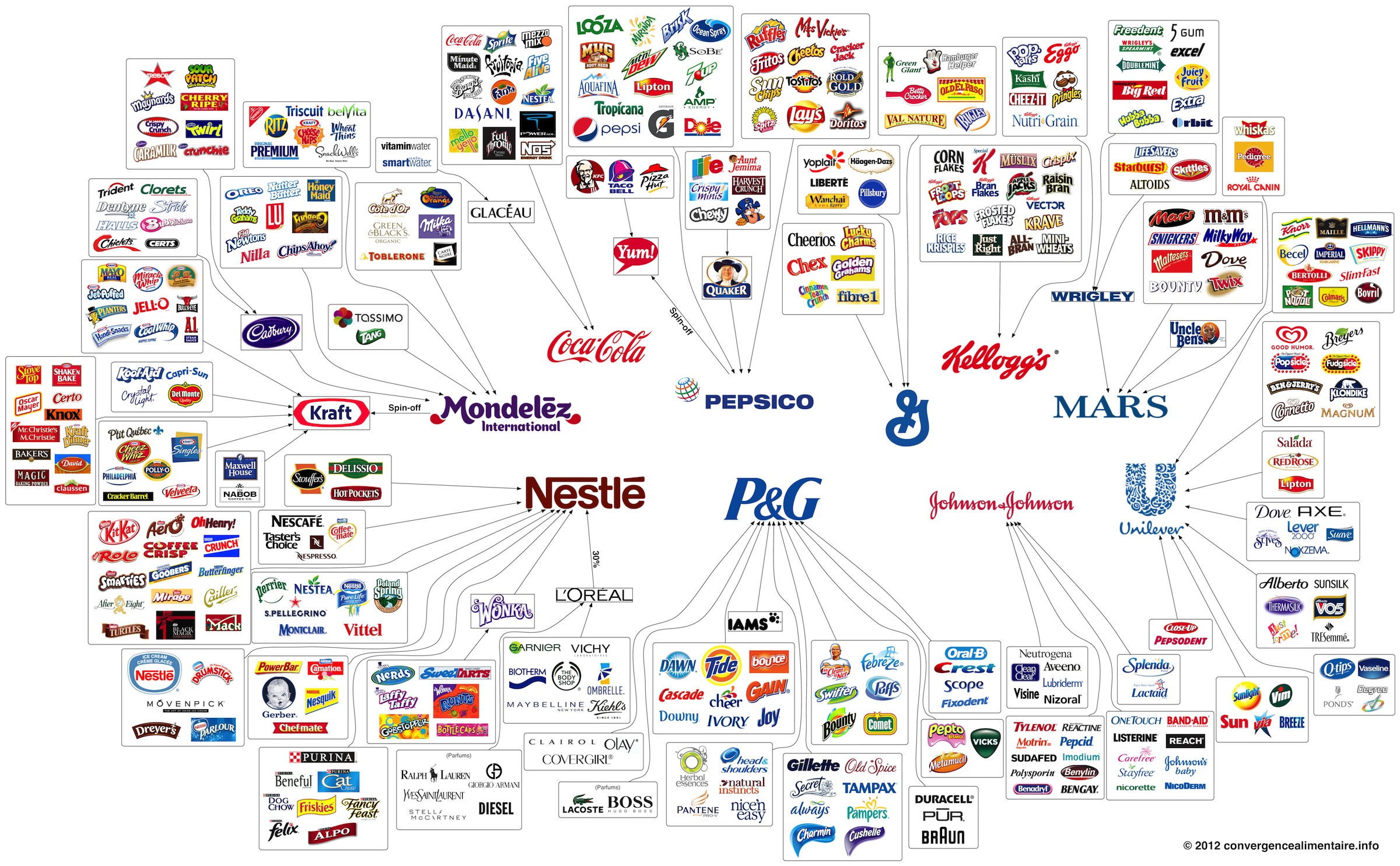
Unfortunately, we have very few choices. (Graph of the few largest companies we're most familiar with: http://www.convergencealimentaire.info/map.jpg) Meanwhile, we are punished for trying to separate ourselves from this system. For example, living off-grid is increasingly difficult, and individuals find themselves fined and forcibly dragged back into the energy grid. (http://offgridsurvival.com/livingoffthegridcrime/) Eating well is next to impossible, as almost everything on the shelves is pumped with GMOs (proven to cause cancer and organ failure in tested animals, among other complications), MSG (proven to affect parts of the brain and central nervous system), pesticides, modified starches and oils, and is stripped of all nutritional value. We are are malnourished while being morbidly obese.

Our political system is tightly reined by wealthy companies. Our laws are heavily influenced by the financial preferences of these corporations. (Graph of the names and companies which control every aspect of our lives--all linked to the Bilderberg Group, which is entrenched in our politics: http://cloud.decryptedmatrix.com/live/wp-content/uploads/2012/06/Ultimate_Bilderberg_Flowchart_Connected_Politicians_Corporations.jpg) It should be known that many of the cosmetic, food, pesticide, and drug additives we use so liberally in the U.S. have been banned in most other first-world countries because they are so dangerous. Marijuana is illegal here not because it hurts users, because it lessens our reliance on some pharmaceuticals--and because its cousin, hemp, eases the monopoly on certain building and clothing materials. (And arguably, because marijuana encourages a different kind of thinking and a release of our egoistic vice-grip on reality as it is--the reality of this ridiculous system. If the issue was personal damages, then alcohol would also be illegal. In a country where we pride ourselves on our individual liberties, we cannot tell adults what they consume in their private lives.)

So what does all this have to do with the threat by people in so many states to secede from the union? I would hope it would be clear, by now. People are tired of being victims in their own country. People are tired of being slowly murdered by their medicine, their food, their banks, and their politicians--even if indirectly. People are tired of being forced to support companies which destroy our planet, abuse the animals we eat (http://www.farmsanctuary.org/learn/factory-farming/), and abuse the money of their consumers. People are tired of being arrested for practicing their constitutional rights. People are tired of paying for war. People are tired of being afraid. There have been plans for years to secede from the union with the intent of rebuilding while out from under this massive, oppressive thumb.

But this is where it gets complicated (hahaha.) No one person can speak for everyone else. Some people will jump on the Secession Bandwagon because they hate Obama (and a shocking number of people hate Obama for purely racist reasons, even if they are not aware of it themselves.) Some people will support secession because they think America is falling apart because of increasingly "tolerance" of homosexuality, religious freedom (including freedom to not partake in any religion), and racial mixing. What's important to note here, however, as that this is not everyone. People are supporting this for many different reasons.

Meanwhile, the media did not begin to highlight this movement until immediately after the 2012 elections, drawing attention not to the core of the movement, but to the population of racists within it. Trust me, this is not accidental. But the movement is not defined by the racism which exists in pockets of its population, just as Occupy Wall Street was not defined by the hateful extremists which cried out for the death of the rich. (God damn it, that was infuriating.) That kind of extremism is harmful to a cause, yes, but it is not the center of it.

I think it is safe to say that no state will actually secede. The driving force behind the threat is the last-ditch effort to grab the attention of our branches of government. "The people are mad," they cry. "Stop ignoring us. Stop forcing us into lifestyles of which we do not approve. Stop misrepresenting us. Stop destroying our planet. Stop seeking profit over people. Stop encouraging ignorance and disease. Stop tricking us out of our money. Stop dangling political puppets in our faces in an attempt to turn us against each other. Stop telling us that consuming will solve our problems. Stop lying. Stop bombing. Stop!"

For the record, I neither support nor ridicule the threats to secede. I feel things are too complicated to be so black and white, and I fear the backlash of those who ridicule the movement will separate the people, rather than uniting them against their abusive Corporate Government. (Rather than divide ourselves, I would suggest looking into this: http://www.represent.us/#video. Represent Us is championing The American Anti-Corruption Act, which "gets money out of politics, so the people can get back in." The following website explains the AACA: http://anticorruptionact.org/.) I also have no idea what the numbers are. I don't know how many people want secede because Obama is black, or how many want to secede because he signed the NDAA, or how many want to seceded for both reasons. From some perspectives, it won't matter. Common ground and wider understanding are what matter. Lincoln didn't abolish slavery strictly for one reason, either, but the eventually result, while not perfect, was absolutely necessary and extremely positive, wouldn't you agree?

Repost: Observations on Capitalism

Capitalism, like Communism, is inherently neither good nor bad. It is a tool which we utilize, and how we utilize it decides its worth. Unfortunately, as with many of our other tools (wealth, technology, self awareness), people are severely unprepared for dealing/living/working in such a system. Some of this unpreparedness has to do with the conscious evolution of our species, but a great deal of it is also linked to our massively underdeveloped (and tightly constrained) educational system. More still, how society raises us to feel about other living things greatly affects our sense of responsibility with people, nature, and society itself. We abuse our economic system (as we abuse wealth, technology, and our capabilities for self awareness & whether or not we strengthen said awareness.)

Therefore, we regulate our economic system, making it not true capitalism but a mixed market economy. People, in their constant abuse of wealth and self worth, see regulation as a threat to their ability to gain MORE MORE MORE, regardless of how impossible and damaging that constant gain is. (Quite literally, we have limited resources and limited labor, grand though both may be.) Meanwhile, much of our regulation is geared toward helping money grow as opposed to avoiding abuse. It's juuust enough to keep the rest of the country from flipping tables over how badly we've destroyed our environment; the damage we've caused to peoples in South America, Africa, and Asia; and the destruction we've brought upon our own values, physical health, and emotional health. We want things more desperately than we want health. We want convenience more desperately than we want peace. Arguably, we've done this to ourselves.

The Kayapo being expelled from their homes for the construction of the Belo Monte Dam,
which will flood 400.000 acres of the Amazon Rainforest in Brazil.


There is another factor, of course. We are carefully sculpted to think this way. After all, this behavior is most profitable for private businesses and for governments, alike. Private business has become so important that it has the same rights as living, breathing people. For example, human beings are losing the right to know what private businesses are feeding them. We're in a fight right now to require the labeling of GMOs, and Monsanto is spending millions of dollars to make sure the public doesn't know they're being killed by the company which feeds them and profits from their ignorance. There is no government effort to protect us, despite the regulation supposedly meant to keep this kind of greedy behavior from harming us. In order for the richest few to remain this way, we must be kept under tighter and tighter control. We must be raised to think it's okay to encourage our children to be violent, slutty, wasteful, and morbidly obese; because then we'll buy up all the military games, bratz dolls, cheetos, and (eventually) Hummers without bothering batting an eye. There's no economic need to instill other values in our children along the way. Thinking this way moves money along, and it supports the companies which support our politicians.

Amendment flier for California, 2012.

Most importantly, however, we must see how the cycle feeds back on itself. The reason we are kept in such a state is because it's not enough to maintain one's wealth. Once a person has grown accustomed to constant growth and wealth, it's never enough. This is the human weakness that encouraged regulation on Capitalism in the first place.

MORE MORE MORE. At the expense of all else. That is why we can't "handle" capitalism. Or communism. Or socialism. For various reasons, we can't handle freedom. We continue to elect assholes to make decisions for us, because we're raised to think only rigid, controlling assholes are the right kinds of people to be leaders. We do it to ourselves.

But do not confuse my hypothesis with hopelessness or pessimism. Rather, I am recognizing a core of the issue. Altering our values, our attitudes toward living things, and our attitudes toward cooperation within systems must become a top priority. (See article, "Cooperation Is a Key To Intelligence.")
In order to create better systems, we must become better people. It starts with us, as individuals. I have to make the decision for myself. I cannot make it for anyone else. I cannot force it on anyone. Trying to do so paints my intent in a negative light and destroys it. I can live the example and help to educate people. I can encourage.

So, arguing about whether any of these existing economic systems are good or bad is a losing battle, in my opinion. We have to make something sustainable. Something new. We have to live the lifestyle we want others to mirror. And we have to hold each other accountable. When Person A abuses his/her power and lessens the quality of life for Person B, we cannot just sit idly by, no matter who profits from Person A's behavior. Agreeing on these basic points is arguably several steps back from being able to point to an existing, fully developed economic system or budget plan, but we've been needing to go back to the drawing board for a while. We keep ignoring the root causes and focusing on the symptoms/effects of the disease.

Repost: Focusing On the Wrong End of Money

I think it's important to stop and realize that no one president's (or vice president's) budget plans are going to fix our problems. Moving our limited resources around does nothing but move where our difficulties are--not eliminate them. Meanwhile, the causes of these difficulties march on, benefitting from our passive ignorance.

It's all short term. We talk about "oh well in 200x so-and-so did such-and-such and it helped this or that!" If we need a major budget overhaul every 4 years, we're doing it wrong.

Stop playing with our limited budget and start playing with the way the money and power work in the first place. Shut down these predatory banks. Strip the power from mass-production food companies to produce (and infect) all of our foodstuffs (from companies like Monsanto and Purdue.) Stop allowing private companies to help police the people, locally and abroad (for example, our red light cameras, and Blackwater, the latter of which is als
o now owned by Monsanto.) Stop allowing pharmaceutical companies to control every aspect of our medical rights (and yes, these should be rights, not an industry. The control includes the production of our medical textbooks, power over the FDA, power over medical studies and scientific breakthroughs, etc.) Stop allowing single corporations (like Amway and Procter & Gamble) to control every product and service we consume, thereby also limiting all of our talents, knowledge, skills, and educational incentives to serving these singular companies. Stop allowing companies to abuse the planet for profit, because without a healthy planet, eventually there IS no profit. There is nothing. The planet is not a money factory. The planet is where we live and coexist with more than just other human beings (which we do poorly) but every other living and non-living system.
Money is not the purpose of life. When we focus our politics on reorganizing money rather than changing the power we give it and the power we give those who hoard all of it, we accomplish nothing. All we do is help those with the money and the power keep playing their game.

Meanwhile, money is not an evil thing. It is a tool. We let our tools run our lives far too often. (Technology is also a tool. We rely so heavily on technology that we abuse it to complete our every task. No one knows how to DO anything anymore.)

I'm tired of budget arguments. They're empty because they were never intended to actually make the country a better place. They're intended to move money around, so long as we keep the status quo afloat. At the same time, I get caught up in pointing out the blatant problems with candidates' budget plans. Because our ability to encourage real change has been wrenched out of our hands, and when we try to exercise it, we are arrested and called terrorists and made to be the enemy of the people.
Sighing all day long.